XAT 2027: 6-Month Preparation Strategy, Daily Study Plan, Mock Tests and Final Revision Roadmap
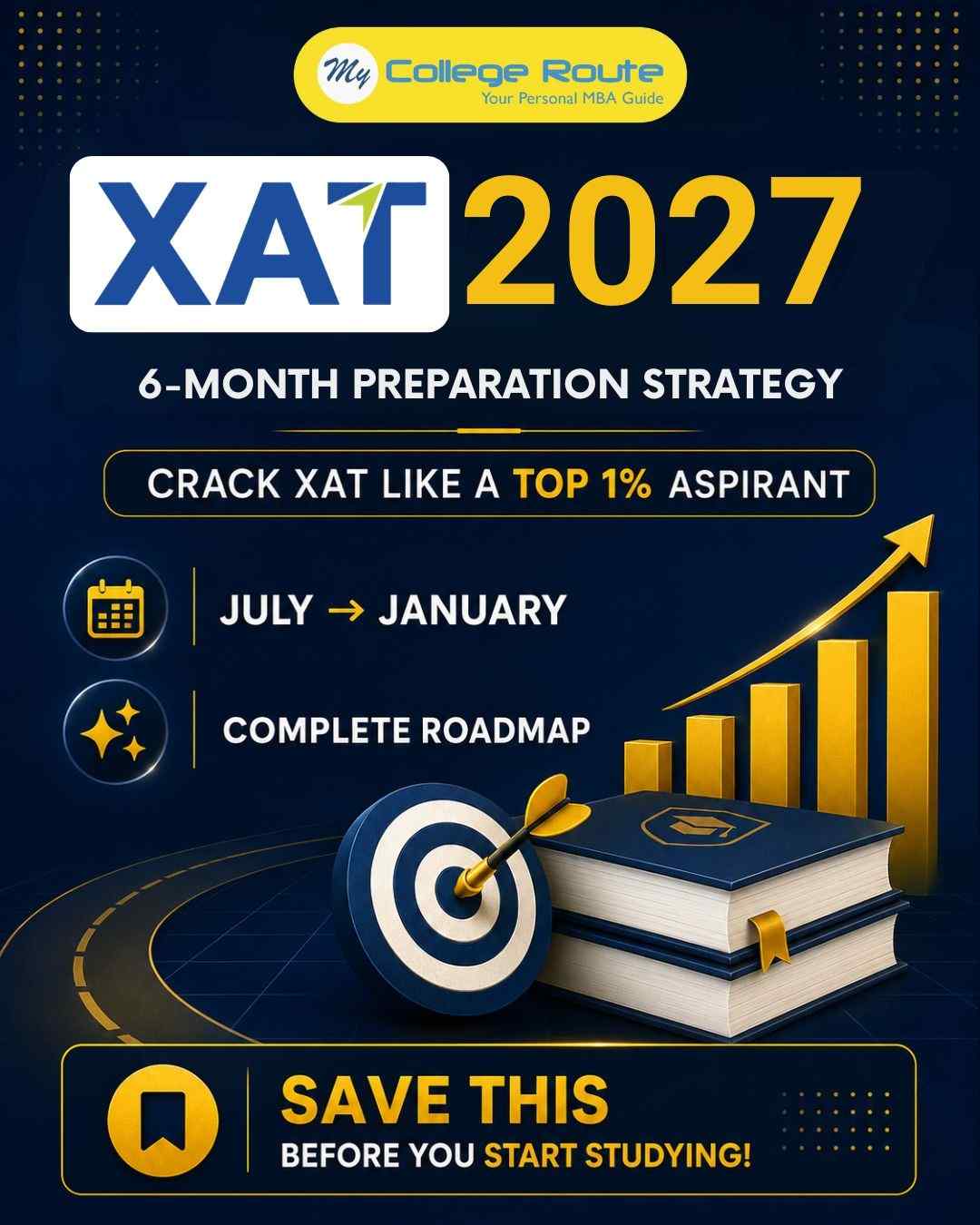
XAT 2027 preparation requires a smart, disciplined and structured approach. Many MBA aspirants start preparing for XAT after CAT, but students who begin early often have a better chance of building strong concepts, improving speed, mastering decision making and scoring a high percentile. A six-month XAT preparation strategy gives enough time to cover the syllabus, practise mock tests, analyse mistakes and revise properly before the exam.
The carousel highlights a complete July to January XAT 2027 preparation roadmap designed for aspirants who want to crack XAT like a top 1% candidate. It focuses on concept building, regular practice, decision making, verbal ability, quantitative aptitude, reading comprehension, mock tests, exam simulation and final revision.
Many aspirants search for questions like how to prepare for XAT 2027 in 6 months, what is the best monthly study plan for XAT, why decision making is important in XAT, how many mock tests are required, what mistakes should students avoid, and how to score 95–99+ percentile in XAT.
This article provides a complete guide on XAT 2027 six-month preparation strategy, monthly roadmap, daily study schedule, section-wise preparation plan, mock test strategy, revision approach and FAQs.
What is XAT 2027?
XAT stands for Xavier Aptitude Test. It is one of India’s most important MBA entrance exams and is accepted by XLRI Jamshedpur and several other reputed B-Schools across India. XAT is known for its unique exam structure and the inclusion of Decision Making, which tests a candidate’s managerial judgement, ethical reasoning and problem-solving ability.
XAT generally tests areas such as:
- Verbal Ability
- Reading Comprehension
- Decision Making
- Quantitative Aptitude
- Data Interpretation
- General Knowledge
- Essay Writing, if included as per the latest exam format
Students should always check the latest official XAT exam pattern before finalizing their preparation plan.
Why Start XAT 2027 Preparation Six Months Early?
A six-month preparation plan gives aspirants enough time to build concepts, practise consistently and improve performance gradually. XAT is not an exam that can be cracked only through shortcuts. It requires conceptual clarity, reading maturity, decision-making practice, time management and regular mock analysis.
Six-month preparation helps students:
- Build strong fundamentals
- Cover important Quant topics
- Improve verbal ability and reading comprehension
- Understand decision-making question patterns
- Start mock tests on time
- Improve speed and accuracy
- Revise regularly
- Avoid last-minute panic
- Track progress month by month
- Target higher percentile with confidence
A structured plan is especially useful for students balancing college, work or other entrance exams.
XAT 2027 Six-Month Roadmap at a Glance
|
Month |
Focus Area |
Main Objective |
|
Month 1 |
Build Foundation |
Master basic concepts |
|
Month 2 |
Strengthen Concepts |
Increase difficulty and start sectionals |
|
Month 3 |
Start Mock Tests |
Attempt weekly full-length mocks |
|
Month 4 |
Improve Speed |
Focus on timed practice and mixed questions |
|
Month 5 |
Exam Simulation |
Take regular mocks in exam-like conditions |
|
Month 6 |
Final Revision |
Revise formulas, vocabulary, DM and past papers |
Month 1: Build Your Foundation
The first month should focus on building strong basics. Students should not rush into mock tests without understanding concepts. The objective is to create a strong base in Quantitative Aptitude, Verbal Ability and Decision Making.
Quantitative Aptitude focus areas
Start with high-utility arithmetic topics such as:
- Percentages
- Profit and loss
- Ratio and proportion
- Time and work
- Averages
- Simple interest and compound interest
- Time, speed and distance
- Number system basics
These topics appear across multiple MBA entrance exams and help build calculation confidence.
Verbal Ability focus areas
Start with:
- Grammar basics
- Vocabulary building
- Reading habits
- Reading comprehension basics
- Sentence correction
- Para jumbles
- Critical reasoning basics
The goal is not to memorize difficult words but to understand usage, tone and context.
Decision Making focus areas
Decision Making is one of the most important XAT sections. In the first month, students should focus on understanding question patterns rather than solving too many difficult sets.
Daily time commitment
The carousel suggests beginning with around 2 hours daily. This is enough for students who want to start consistently without burnout.
Month 1 goal
By the end of Month 1, students should have:
- Revised basic Quant formulas
- Developed a reading habit
- Understood basic XAT section structure
- Started Decision Making practice
- Built a simple error notebook
- Created a realistic study routine
Month 2: Strengthen Concepts
The second month is about increasing difficulty. Once the basics are clear, students should begin solving moderate-level questions and start sectional tests.
Suggested daily structure
- Quantitative Aptitude: 1 hour
- Verbal Ability: 1 hour
- Decision Making: 45 minutes
- Reading Comprehension: 30 minutes
Focus areas for Month 2
Students should focus on:
- Solving tougher questions
- Building speed and accuracy
- Improving question selection
- Analysing performance regularly
- Attempting sectional tests
- Identifying weak topics
Why sectional tests matter
Sectional tests help students understand their performance in individual areas. They show whether the student is weak in Quant, Verbal, RC or Decision Making. They are less tiring than full-length mocks and useful during the concept-strengthening stage.
What to track in Month 2
Students should track:
- Accuracy percentage
- Time taken per question
- Number of skipped questions
- Topics causing repeated mistakes
- Improvement in reading speed
- Decision Making accuracy
Month 2 goal
By the end of Month 2, students should feel comfortable solving moderate-level questions and should have a clear idea of their strong and weak areas.
Month 3: Start Mock Tests
The third month is the right time to begin full-length mock tests. At this stage, students should not chase high scores immediately. The first goal is to understand exam pressure, time allocation and weak areas.
Mock test target
The carousel recommends:
- 2 full-length mocks every week
- Detailed analysis after every mock
- Fixing weaknesses instead of chasing scores
Why mock analysis matters more than mock score
Many aspirants take mocks but do not analyse them properly. This is a major mistake. Mock analysis helps students understand:
- Which topics are weak
- Which questions took too much time
- Where accuracy dropped
- Which section created pressure
- Whether question selection was poor
- Whether guesses reduced the score
How to analyse XAT mocks
After every mock, divide mistakes into:
Conceptual mistakes
You did not know the topic or method.
Calculation mistakes
You knew the method but made a numerical error.
Reading mistakes
You misread the question or option.
Decision-making mistakes
You chose an emotionally attractive but logically weak option.
Time-management mistakes
You spent too long on one question.
Month 3 goal
By the end of Month 3, students should have attempted multiple mocks and understood their performance pattern.
Month 4: Improve Speed
The fourth month should focus on speed, accuracy and mixed practice. At this stage, students should already know the basics and should now work on exam-level performance.
The carousel sets a target of 95 percentile+ and recommends daily practice with:
- Timer practice
- Mixed questions
- Decision Making sets
- Reading Comprehension
- Geometry
- Algebra
Why speed matters in XAT
XAT is not only about solving questions. It is about solving the right questions in limited time. Students must know when to attempt, skip and return.
How to improve speed
Students can improve speed by:
- Practising with a timer
- Solving mixed-topic quizzes
- Using short calculation methods
- Avoiding overthinking in Decision Making
- Reading RC passages actively
- Revising formulas regularly
- Avoiding emotional attachment to difficult questions
Quant focus in Month 4
Students should add:
- Algebra
- Geometry
- Modern math basics
- Data Interpretation
- Mixed arithmetic sets
Verbal and RC focus in Month 4
Students should practise:
- Reading comprehension
- Critical reasoning
- Para jumbles
- Vocabulary in context
- Sentence completion
Month 4 goal
By the end of Month 4, students should be faster, more accurate and better at selecting questions.
Month 5: Exam Simulation
Month 5 should feel like the real exam environment. Students should start taking mocks seriously and simulate the actual exam experience.
Mock test target
The carousel recommends:
- 3 mock tests every week
Focus areas
Students should focus on:
- Accuracy
- Time management
- Question selection
- Revision
- Exam temperament
How to simulate the XAT exam
To create exam-like practice:
- Take mocks at the same time as the expected exam slot.
- Sit without distractions.
- Avoid pausing the test.
- Use only permitted rough work.
- Do not check answers during the mock.
- Analyse after completion.
- Maintain an error log.
What to improve in Month 5
Students should improve:
- Attempt strategy
- Section order
- Time allocation
- Skipping decisions
- Accuracy under pressure
- Reading speed
- Decision-making logic
- Confidence
Month 5 goal
By the end of Month 5, students should be able to attempt mocks with a stable strategy and controlled pressure.
Month 6: Final Revision
The final month is not for starting new topics. It is for revision, mock analysis and confidence building.
Final revision checklist
The carousel recommends revising:
- Formula book
- Vocabulary
- Decision Making
- Previous year papers
- Mock analysis
- No new topics
Why no new topics?
New topics in the final month may create confusion and reduce confidence. Instead, students should strengthen known topics and improve accuracy.
What to revise in Quant
- Arithmetic formulas
- Algebra basics
- Geometry formulas
- DI calculation methods
- Common shortcuts
- Previous mistakes
What to revise in Verbal Ability
- Vocabulary notes
- Grammar rules
- RC strategies
- Common option traps
- Para jumble methods
- Critical reasoning logic
What to revise in Decision Making
- Ethical decision-making cases
- Business situation cases
- Stakeholder-based problems
- Previous year DM sets
- Mistake patterns
- Option elimination logic
Month 6 goal
By the end of Month 6, students should be exam-ready, confident and clear about their attempt strategy.
XAT 2027 Daily Study Plan
The carousel suggests a practical daily study plan for Monday to Friday:
|
Section |
Daily Time |
|
Quantitative Aptitude |
90 minutes |
|
Verbal Ability |
60 minutes |
|
Decision Making |
45 minutes |
|
Current Affairs |
30 minutes |
|
Reading |
30 minutes |
Weekend plan
- Saturday: Mock test
- Sunday: Mock analysis
This structure is easy to follow because it balances all major XAT areas and gives dedicated time for review.
Section-Wise XAT 2027 Preparation Strategy
Quantitative Aptitude and Data Interpretation
Quant preparation should begin with arithmetic and then move toward algebra, geometry and DI.
Important Quant topics
- Percentages
- Profit and loss
- Ratio and proportion
- Time and work
- Time, speed and distance
- Averages
- Number system
- Algebra
- Geometry
- Mensuration
- Data Interpretation
- Probability basics
How to prepare Quant
- Revise concepts first.
- Practise topic-wise questions.
- Maintain a formula book.
- Use timed quizzes.
- Analyse calculation mistakes.
- Solve mixed questions weekly.
Verbal Ability and Reading Comprehension
XAT Verbal Ability requires reading maturity and logical understanding.
Important Verbal topics
- Reading comprehension
- Vocabulary
- Grammar
- Para jumbles
- Critical reasoning
- Sentence correction
- Fill in the blanks
- Inference questions
How to prepare Verbal
- Read daily.
- Practise RC passages.
- Learn vocabulary in context.
- Analyse wrong options.
- Avoid extreme answer choices.
- Practise critical reasoning regularly.
Decision Making
Decision Making is a unique and crucial part of XAT. Many students ignore it and lose marks.
How to prepare Decision Making
- Solve previous year DM sets.
- Understand stakeholder concerns.
- Avoid emotional decisions.
- Choose practical and ethical options.
- Eliminate extreme choices.
- Practise business and social scenarios.
- Review every wrong answer carefully.
General Knowledge and Current Affairs
GK may not always affect shortlisting in the same way as other sections, but it can matter in later evaluation stages and interviews.
What to study
- Business news
- Economy
- Government schemes
- Awards
- Sports
- International events
- Mergers and acquisitions
- Budget highlights
- Important appointments
- Static GK basics
How to Score 95–99+ Percentile in XAT
Scoring 95–99+ percentile requires consistency, smart practice and regular analysis.
Key success habits
- Study daily
- Build basics early
- Practise Decision Making from the beginning
- Take mocks regularly
- Analyse mistakes deeply
- Improve reading speed
- Revise formulas
- Practise time management
- Avoid new topics at the end
- Stay calm during the exam
Aspirants who start early and follow the right strategy can build enough preparation depth to target top XAT colleges.
Target Colleges Through XAT 2027
The carousel mentions top target colleges for XAT aspirants such as:
- XLRI Jamshedpur
- XIM University
- IMT Ghaziabad
- Goa Institute of Management
- BIMTECH
- Great Lakes Chennai
- TAPMI
- FORE School of Management
- IRMA
Students should shortlist colleges based on score, cutoff, fees, placements, specialization, location and ROI.
Location Advantage for XAT 2027 Aspirants
Students often search for XAT colleges by city:
- XAT colleges in Delhi NCR
- XAT colleges in Mumbai
- XAT colleges in Pune
- XAT colleges in Chennai
- XAT colleges in Bengaluru
- XAT colleges in Bhubaneswar
- XAT colleges in Goa
- XAT colleges in Manipal
- XAT colleges in Anand
- XAT colleges in Jamshedpur
Quick Snapshots
How can I prepare for XAT 2027 in 6 months?
Start with basics in Month 1, strengthen concepts in Month 2, begin mocks in Month 3, improve speed in Month 4, simulate exams in Month 5 and revise in Month 6.
What should I study first for XAT?
Start with Quant basics, daily reading, vocabulary, grammar and Decision Making question patterns.
How many mocks should I take for XAT 2027?
Start with sectional tests in Month 2, take 2 full-length mocks weekly in Month 3 and move to 3 mocks weekly during exam simulation.
Why is Decision Making important in XAT?
Decision Making is unique to XAT and tests managerial judgement, ethical reasoning and practical decision-making.
Can I score 95+ percentile if I start now?
Yes, with a structured six-month plan, consistent practice, mock analysis and revision, students can target 95+ percentile.
How My College Route Helps XAT Aspirants
My College Route helps MBA aspirants with:
- XAT exam updates
- Preparation strategy
- Syllabus and pattern guidance
- Mock test planning
- College shortlisting
- XAT accepting colleges
- Fees and placement comparison
- ROI analysis
- Admission deadline tracking
- City-wise MBA options
Students can use My College Route to prepare smarter and shortlist colleges more confidently.
Conclusion
XAT 2027 preparation becomes easier when students follow a structured six-month roadmap. The right approach is to build foundations, strengthen concepts, start mocks early, improve speed, simulate the exam and revise without starting new topics at the end.
Students should remember that XAT is not just a knowledge test. It checks speed, accuracy, decision-making ability, reading maturity and exam temperament. A student who studies consistently, analyses mistakes and improves strategy every month can target a strong percentile.
Plan smart. Prepare early. Stay consistent. With the right effort at the right time, XAT 2027 can become a strong gateway to top MBA colleges.
FAQs:
1. Is six months enough for XAT 2027 preparation?
Yes, six months are enough if students follow a structured plan with concept building, practice, mock tests and revision.
2. How should I start XAT preparation?
Start with basic Quant topics, reading habits, grammar, vocabulary and Decision Making question patterns.
3. When should I start XAT mock tests?
Students should start full-length mocks around the third month after building basic concepts and attempting sectionals.
4. How many hours should I study daily for XAT?
Students can start with 2 hours daily and gradually increase to 4–5 focused hours depending on preparation stage.
5. How important is Decision Making in XAT?
Decision Making is very important because it is unique to XAT and can strongly impact overall performance.
6. How can I improve XAT Quant?
Revise formulas, practise arithmetic, algebra, geometry and DI, solve mixed questions and analyse mistakes.
7. How can I improve XAT Verbal Ability?
Read daily, practise RCs, revise grammar, build vocabulary in context and analyse incorrect options.
8. Should I study current affairs for XAT?
Yes, students should dedicate regular time to business, economy, national and international current affairs.
9. What is the best weekly plan for XAT?
Study QA, VA, DM, current affairs and reading from Monday to Friday, take a mock test on Saturday and analyse it on Sunday.
10. What are the biggest XAT preparation mistakes?
Ignoring Decision Making, starting mocks late, not analysing mocks, poor time management and skipping essay practice are common mistakes.
11. Should I solve only easy questions?
No. Students should gradually increase difficulty and practise mixed questions to improve exam readiness.
12. How many mocks are enough for XAT?
The number varies, but students should take regular mocks from Month 3 and increase frequency during Month 5.
13. What should I do in the final month?
Revise formulas, vocabulary, Decision Making, previous year papers and mock mistakes. Avoid starting new topics.
14. Can I target 99 percentile in XAT with six months?
Yes, a 99 percentile target is possible with strong consistency, mock analysis, accuracy improvement and disciplined revision.
15. How does My College Route help XAT aspirants?
My College Route helps students with XAT preparation insights, college comparison, fees, placements, ROI, cutoffs and admission guidance.
© 2026 mycollegeroute.com All Rights Reserved. Website designed by Orbit Inhouse