Beyond the Major: How IMT Ghaziabad Builds Its PGDM Experience
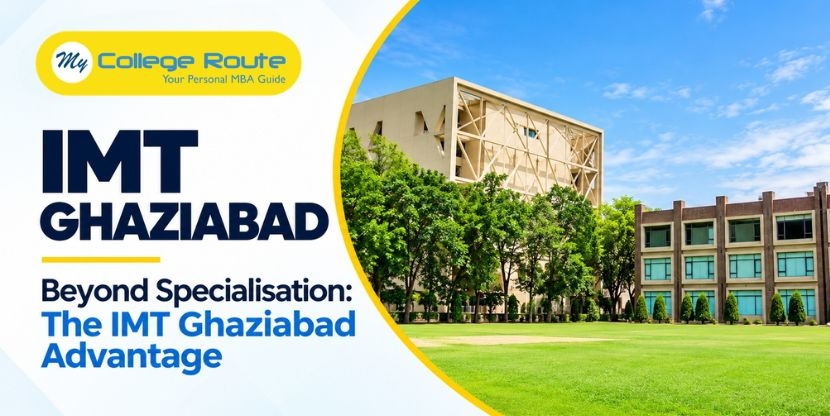
A PGDM can look deceptively simple on paper. There are the familiar management subjects, a few specialisation choices, an internship somewhere in the middle and placements waiting at the other end. Put the brochures of several business schools side by side and, at first glance, the differences can become surprisingly difficult to see.
The distinctions usually emerge elsewhere: in what students encounter before they specialise, how much of the curriculum is built around applying what they learn, when technology and analytics enter the picture, and how closely the academic experience is connected with the roles they may eventually pursue.
IMT Ghaziabad’s flagship PGDM is interesting to examine from that perspective. Its current two-year, full-time residential programme moves from a broad management foundation into core learning, practical application and deeper functional study, while bringing case learning, personal development, technology, analytics and career-oriented thinking into the larger experience.
That is also the more useful way for My College Route to look at a management programme. A college comparison should not stop at asking which institute has the stronger name or the higher package. The better question is what actually happens between admission and graduation—and how those two years are designed to move a student towards professional capability.
In IMT Ghaziabad’s case, the story is less about any single specialisation and more about howthedifferent pieces of the PGDM fit together.
That combination matters.
The first challenge in management education is not choosing between Marketing and Finance. It is learning to look at a business problem from more than one angle.
A company deciding whether to launch a new product, for instance, is dealing with much more than a marketing question. There are costs to consider, demand to estimate, operational implications to understand and organisational capabilities to assess. The ability to connect those perspectives becomes increasingly important as students move through the programme.
Case learning adds another dimension. Instead of approaching management only through concepts and definitions, students are expected to work with situations in which the problem may not be neatly defined. Spreadsheet modelling brings quantitative thinking closer to practical business analysis, while the Personal Growth Lab recognises that management education also involves developing the individual who will eventually make those decisions.
For a student comparing PGDM colleges in Delhi NCR, these details are more revealing than a long list of course titles. They indicate what the programme expects students to build before asking them to specialise.
The Core Is About Seeing the Business as a Whole
Once that foundation is established, the programme moves into the broader management disciplines—marketing, finance, operations, human resources, economics, accounting, organisational behaviour and strategy.
These are hardly unusual subjects for a management programme. Their importance lies in what they allow students to do together.
Business functions do not operate independently once students enter an organisation. A strategic decision can affect finance and operations. A product decision can alter supply chains. A technology investment can change organisational processes. A people decision can influence productivity and eventually financial performance.
This is why a strong common core still matters even as management education becomes more specialised and technology-driven.
IMT's current curriculum retains that breadth while introducing areas such as Digital Business Strategy, entrepreneurship and Data Analytics and AI for Business into the wider management learning journey.
The result is a curriculum that does not ask students to choose between “traditional management” and “new-age business.” It treats the former as the foundation through which the latter has to be understood.
That is an important distinction for anyone researching MBA and PGDM colleges in India. Technology may change how businesses operate, but students still need to understand the businesses themselves.
The Interesting Part Begins When Learning Has to Be Applied
A curriculum becomes more meaningful when it shows what students are expected to do with what they have learned
This is where IMT's practice-oriented components become relevant. The current PGDM structure brings together the summer internship with learning around business research or startup incubation, technology readiness, business communication, design thinking, critical thinking, sustainability and social responsibility, and the legal context of business.
These elements address a problem that every management programme eventually has to confront: knowing a framework is not the same as knowing when and how to use it.
A classroom can teach competitive strategy. A business situation may force a student to decide which information is actually important before any strategic framework can be applied.
A textbook can explain consumer behaviour. A live project may involve customers whose motivations are unclear and data that does not tell a complete story.
Design thinking becomes useful when the problem itself needs to be understood before a solution is proposed. Critical thinking becomes useful when there are several plausible answers and students have to determine which one can actually stand up to scrutiny.
This is where a PGDM begins to move beyond academic knowledge.
For a student comparing management colleges in Delhi NCR, the question worth asking is not simply whether a programme has live projects or internships. It is how those experiences fit into the larger learning journey
Technology Is No Longer a Separate Conversation
There was a time when technology in a management programme could be treated as a specialist interest. That distinction is becoming increasingly difficult to maintain.
Managers now work with data, digital platforms, automation and artificial intelligence regardless of whether their job title contains the word “technology.”
IMT's current PGDM reflects that shift. Data Analytics and AI for Business forms part of the broader core, while students can explore deeper areas involving business analytics, forecasting, generative AI and advanced analytics. Technology-oriented learning also extends into digital products, big data, cloud, IoT and other emerging business applications.
The more useful way to interpret this is not that every management student is being trained to become a technical specialist.
Instead, the programme is acknowledging that a manager increasingly has to understand the business implications of technology.
A marketing manager may need to interpret customer data. A finance professional may work alongside analytical systems. An operations manager may be responsible for digitally enabled supply chains. A product manager may spend much of the day translating between customer needs, business objectives and technology teams.
The management graduate therefore needs enough technological awareness to ask the right questions, evaluate possibilities and work effectively with specialists.
That makes the presence of AI and analytics within a management curriculum meaningful only when it remains connected to business decision-making. At IMT, those areas sit within a larger programme that continues to teach finance, marketing, operations, people and strategy.
The Major Is Where Breadth Starts Turning Into Depth
Only after students have built that wider management base does the question of functional depth become more important.
The flagship PGDM allows students to develop expertise through four major areas: Marketing, Finance, Operations and Human Resource Management.
But the useful distinction is not simply that these four options exist. It is what students can begin exploring within them.
Marketing can move from consumer behaviour and sales into digital marketing, marketing research and analytics, product and brand management, CRM, e-commerce and other specialised areas.
Finance can move beyond the fundamentals into valuation, financial statement analysis, fintech, derivatives, portfolio management, risk, financial analytics, investment banking and related areas.
Operations can lead towards supply-chain management, sourcing, project management, operations strategy and digital supply-chain applications, while HR offers a progression through areas such as staffing, compensation, learning and development, organisational design, performance management and leadership.
The point is not to reproduce the entire elective catalogue.
It is that a major can become more useful when it gives students enough room to discover what within a broad function actually interests them.
A student may begin with “Marketing” as a general preference and gradually find an interest in brand management, customer analytics or product. A Finance student may discover a stronger inclination towards risk or investment banking than towards general corporate finance.
For someone comparing PGDM colleges in India, this is a more meaningful question than simply counting the number of specialisations: how much depth can I actually develop once I know where myinterests lie?
From Specialisation to the Role You Want to Build Towards
This is where IMT's current career orientation adds another layer to the programme.
The institute describes its PGDM architecture around career tracks aligned to career roles, and its recent placement approach has moved towards a role-competency-based framework.
That distinction is important.
A specialization is an academic category. A career role is much more specific.
A Marketing graduate may eventually work in brand management, sales, digital marketing, product management or customer analytics. A Finance student could move towards investment banking, financial analytics, corporate finance, risk or wealth management. Operations can open different routes across supply chain and project-oriented roles.
The distance between a specialisation and a role is where much of management education becomes practical.
This is why the internship matters as well. Students get an opportunity to see how the work actually feels before making assumptions about a career based only on classroom exposure.
A student who imagines Marketing as advertising may discover an interest in analytics. Someone entering Finance with one career in mind may find that another function suits their strengths better.
The value of the two-year PGDM, then, is partly in allowing this understanding to evolve. For students comparing MBA colleges in Delhi NCR, it is worth examining when that career direction begins to take shape and whether the programme gives students enough exposure to make informed choices.
The Part of the PGDM That Happens Outside the Timetable
There is another element of a residential management programme that cannot be understood through the curriculum alone.
Students spend two years working with peers from different academic and professional backgrounds, taking part in group projects, case discussions, competitions, clubs and other activities. IMT Ghaziabad describes its residential environment as a wider learning ecosystem built around collaboration, peer learning and development beyond formal classroom teaching.
This matters because management is a highly social discipline.
A future manager needs to be able to persuade someone who disagrees with them, divide responsibility across a team, negotiate priorities and communicate an idea under pressure. These are not capabilities that develop only through examinations.
Peer learning can also change the way students understand business problems. Someone from an engineering background may approach a case differently from someone who studied commerce. Another student may bring work experience or exposure to a completely different industry.
That diversity becomes part of the learning environment.
IMT's reported alumni network of more than 15,000 professionals worldwide adds another layer to that ecosystem, while the institute also reports academic relationships with institutions across multiple countries.
The numbers themselves do not guarantee a particular outcome for an individual student. What they indicate is the scale of the network surrounding the program.
Placement Numbers Make More Sense When Read as Career Data
Placement statistics are unavoidable when students compare business schools. But a single highest-package number tells very little about what the average student may actually experience.
In its interim placement update for the 2024–26 batch, IMT Ghaziabad reported that 400 students had been placed as of December 31, 2025, with 110 companies participating. The highest CTC at that stage was Rs.35 lakh, while the average stood at Rs. 18.89 lakh and the median at Rs.17.56 lakh. The institute also reported that 25% of offers had come through pre-placement offers (PPOs).
The spread of roles and sectors provides more context.
Recruitment reported by the institute included BFSI, consulting, IT/ITES, FMCG and consumer businesses, investment banking, global capability centres and e-commerce. Roles included strategy, management consulting, business analytics, product management, sales leadership and other specialised functions.
That connects directly with the role-oriented approach discussed earlier.
If companies are hiring for specific capabilities, then the question for a student is not simply “What package can I get?” It is also “What kind of roles does this programme appear to prepare students for, and does that match the direction I want?”
That is a much more useful way of reading placement data.
Where IMT Ghaziabad Fits in the PGDM Comparison
IMT Ghaziabad has been part of India's management education landscape since 1980. Its flagship PGDM is a two-year, full-time residential programme, with the institute currently holding AACSB accreditation and the PGDM carrying AICTE approval, NBA accreditation and AIU recognition of equivalence to an MBA.
Those credentials establish an important baseline, but they do not by themselves explain the experience a current applicant is choosing.
The more revealing part is the structure around them.
The current PGDM brings together a broad management foundation, case-based learning, personal development, practical application, technology and analytics, functional depth, internship experience and career-role orientation.
Seen this way, IMT Ghaziabad is not simply a name that needs to be positioned against other PGDM colleges in Delhi NCR. It is a particular approach to management education that can be examined on its own terms—and then compared with alternatives.
How My College Route Would Read the Programme
This is where the My College Route approach becomes particularly useful.
A student does not necessarily need another ranking table that places business schools in an order and attaches a placement number to each one. What is more useful is a framework that helps reveal the differences hidden behind similar-looking PGDM structures.
For IMT Ghaziabad, that means looking at the progression: What happens before specialisation? How does the common core build an understanding of business? Where does practical learning enter? How seriously are technology and analytics integrated? What depth can students develop within a major? Does the programme help connect academic choices with actual career roles? And what does the placement data reveal beyond the highest package?
Those questions can then be asked of every other college on a student's shortlist.
That is the value of a comparison platform such as My College Route. The objective is not to decide that one management programme is universally better than another. It is to make the differences easier to understand so that students can judge those differences against their own priorities.
Beyond the Major
The strongest way to understand a two-year PGDM is perhaps to look at the progression rather than the final specialisation.
At IMT Ghaziabad, students begin with the fundamentals of business and the skills needed to approach business problems. They move into a broader management core, encounter practical and experiential learning, develop familiarity with analytics and emerging technology, and then build greater functional depth through their chosen major. Internships, peer learning and career-oriented preparation bring the academic experience closer to the professional roles waiting beyond campus.
That makes the major only one part of the story.
For a student exploring MBA and PGDM colleges in India, the more revealing comparison is what happens around it-what the programme teaches before students specialise, how it encourages them to apply what they know and how clearly it helps them connect their interests with the kind of work they eventually want to do.
That is the lens through which IMT Ghaziabad's flagship PGDM is worth examining: not simply as a qualification or a collection of specialisations, but as a two-year process of moving from broad business understanding towards professional direction
© 2026 mycollegeroute.com All Rights Reserved. Website designed by Orbit Inhouse