From Foundation to Application: What Makes GLBIMR's PGDM Different
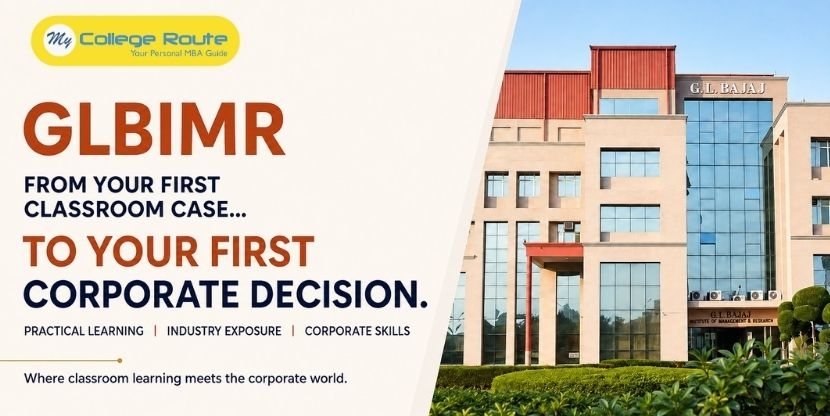
A management classroom can teach a student what a balance sheet means, how a marketing strategy is structured, or why organisations behave in certain ways. The harder part is understanding what happens when these ideas have to work together in an actual business situation. A company does not divide its problems according to textbook chapters. A decision about marketing can affect finance, operations can influence customer experience, and a change in strategy can eventually reshape the way people work.
This is where GL Bajaj Institute of Management & Research (GLBIMR) takes an interesting approach to its PGDM programme.
The institute's pedagogy is built around the FAIR model-Foundation, Application, Integration and Reinforcement. GLBIMR describes this model as a way of making the institute distinct from other business schools. The idea is to begin with fundamental concepts, move towards their application, and then integrate them with real-life business problems. The institute also states that its syllabus is reviewed and analysed every year to keep pace with developments in industry and research.
The strength of the idea lies in its simplicity. Students are not expected to wait until they enter the corporate world to discover whether what they learned in class actually works. The attempt is to introduce that connection while they are still learning.
That makes the GLBIMR PGDM worth looking at from a slightly different perspective. Instead of beginning with a long list of subjects or placement claims, it is more useful to ask a basic question: How does the programme turn management concepts into something students can actually use?
The answer starts with the structure of the programme itself.
GLBIMR offers a two-year, full-time PGDM programme approved by AICTE, with students required to pursue dual or major-minor specialisation from the streams offered by the institute. These include Marketing, Finance, Human Resource Management, Data Analytics, Operations Management, International Business, Strategy and Consultancy, and Entrepreneurship.
That flexibility is relevant because business functions are becoming increasingly connected. A student interested in marketing may also want an understanding of analytics. Someone pursuing finance may find data skills useful in decision-making. A future entrepreneur may need to understand operations and people management alongside strategy.
A dual-specialisation or major-minor structure does not automatically make a programme better, but it does give students the opportunity to look at business from more than one functional perspective. And that fits naturally with the larger philosophy behind the GLBIMR PGDM: management is easier to understand when its different pieces are connected.
The industry component is another concrete part of the programme. GLBIMR states that 20% of each course is taught by industry experts. It also highlights corporate interface, industrial visits and live projects as part of the PGDM experience.
That 20% figure is worth noticing because there is a difference between saying that a college occasionally invites industry professionals for guest lectures and stating that industry experts are involved in delivering a portion of each course.
For a student, the practical difference can be significant. A concept that looks perfectly straightforward in a textbook can become more complicated when discussed by someone who has dealt with customers, budgets, deadlines, teams and business pressures. Industry exposure can bring those complications into the classroom and help students understand that there is rarely a single formula for solving a business problem.
GLBIMR's pedagogy also includes simulation exercises, along with classroom lectures and other learning activities. The institute explains that simulations place participants in situations designed to resemble real events, allowing them to function in roles expected of them in those situations. Its pedagogy also includes corporate interface activities such as alumni sessions, mock interviews with corporate experts, corporate interaction series, industrial visits and summer internships.
This is where the word "application" in FAIR starts becoming meaningful.
Learning through a simulation is different from reading about a managerial decision. Participating in a corporate interaction is different from memorising an industry example. Presenting an idea, defending a viewpoint or responding to questions forces a student to work with knowledge rather than simply recall it.
There is another part of the GLBIMR PGDM that fits particularly well into this approach: the minor project.
The institute describes the minor project as an integral part of the PGDM programme. Students are assigned two credits for the project and conduct secondary and primary research on one company throughout all three trimesters. The project is intended to develop an in-depth understanding of the company and is designed as a cross-functional experience.
There is something valuable about staying with one organisation for that length of time.
Instead of jumping from one short case study to another, students have an opportunity to understand a company in greater depth-from its beginnings to its present position—and examine it through different functional lenses. Marketing, finance, operations, people and strategy begin to appear as parts of one organisation rather than as unrelated subjects.
That is precisely the kind of connection that can be difficult to create through classroom theory alone.
The same principle continues into the Summer Internship Programme. GLBIMR describes the summer internship as an essential part of its PGDM curriculum. After the first year, students undertake a 6–8 week internship with an organisation, working on a specific assignment related to their specialisation and submitting a project report based on the experience.
An internship naturally changes the nature of learning.
There are deadlines that cannot be moved simply because an examination is approaching. There are colleagues to work with, information to collect, expectations to understand and a project that eventually has to be presented. The student is no longer solving a hypothetical business problem. They are learning how an organisation actually operates.
For students comparing the Best MBA Colleges in Delhi NCR, that practical connection can be an important factor. The more useful question is not simply which institute has the right name, but how its management programme prepares students for the realities of the workplace.
The learning does not stop with the core curriculum either. GLBIMR offers Value Added Certification Courses beyond its regular courses, with the schedule and structure adjusted according to industry requirements. Its official programme information lists courses and modules covering areas such as AI for Managers, Python and Blockchain Management, Advanced Financial Modelling, SEO and Google Analytics, Big Data Analytics, SAP–Operations, Design Thinking, Lean Six Sigma, Digital Marketing and Ethical Hacking, among others. These courses are offered as value additions beyond the regular curriculum.
The significance here is not simply the number of certificates a student can collect.
The more interesting point is the range of skills being introduced alongside traditional management subjects. Technology, analytics, digital platforms, financial modelling and design thinking are increasingly part of how modern businesses operate. Giving management students opportunities to explore such areas can help them develop a broader professional toolkit.
GLBIMR also highlights global academic exposure through international exchange programmes, along with an international excursion opportunity for meritorious students as part of its PGDM programme highlights.
Meanwhile, the institute's Corporate Resource Centre describes corporate engagement as a year-round activity rather than something limited to summer training and final placements. It works on industry interaction, maintains relationships with potential recruiters and tracks changing requirements to help prepare students accordingly.
This distinction is important when evaluating a management institute in Greater Noida. Career preparation is not only about what happens when recruitment season begins. It is also about the experiences students accumulate before they reach that stage.
A case discussion, an industry session, a simulation, a company project, a certification course and an internship may appear to be separate activities. Within a well-connected learning model, however, they can serve the same purpose: helping students move gradually from knowing something to being able to use it.
That brings us back to FAIR.
Foundation gives students the concepts. Application asks them to use those concepts. Integration connects them with real business problems. Reinforcement strengthens the learning through continued practice and exposure.
GLBIMR's approach is therefore less about making a dramatic distinction between classroom learning and practical learning and more about reducing the distance between the two.
For students looking at PGDM colleges in Greater Noida and evaluating options that may appear while searching for a Top MBA College in Greater Noida, that is a useful distinction to understand. A programme may have the right specialisations, industry exposure and internship opportunities, but the real question is how these elements fit together.
At GLBIMR, they form part of a broader attempt to make management education more connected to the way business actually works.
This is also where My College Route can help aspirants make a more informed comparison. Rather than looking at business schools only through rankings, fees or placement figures, students can examine the details that shape their two-year experience: PGDM curriculum, specialisations, pedagogy, industry exposure, live projects, internships, certifications and career preparation.
Because choosing a PGDM college in Delhi NCR is ultimately not just about choosing a qualification.
It is about choosing how you are going to learn.
And perhaps that is the most useful way to understand the GLBIMR PGDM. Its distinguishing idea is not one isolated feature, but the attempt to connect the stages of learning-from Foundation to Application, Integration and Reinforcement-so that management concepts gradually move out of the textbook and closer to the world in which students will eventually have to use them.
© 2026 mycollegeroute.com All Rights Reserved. Website designed by Orbit Inhouse