CAT 2026 Registration Trends: Last 5 Years Data, Expected Attendance and IIM Indore Analysis
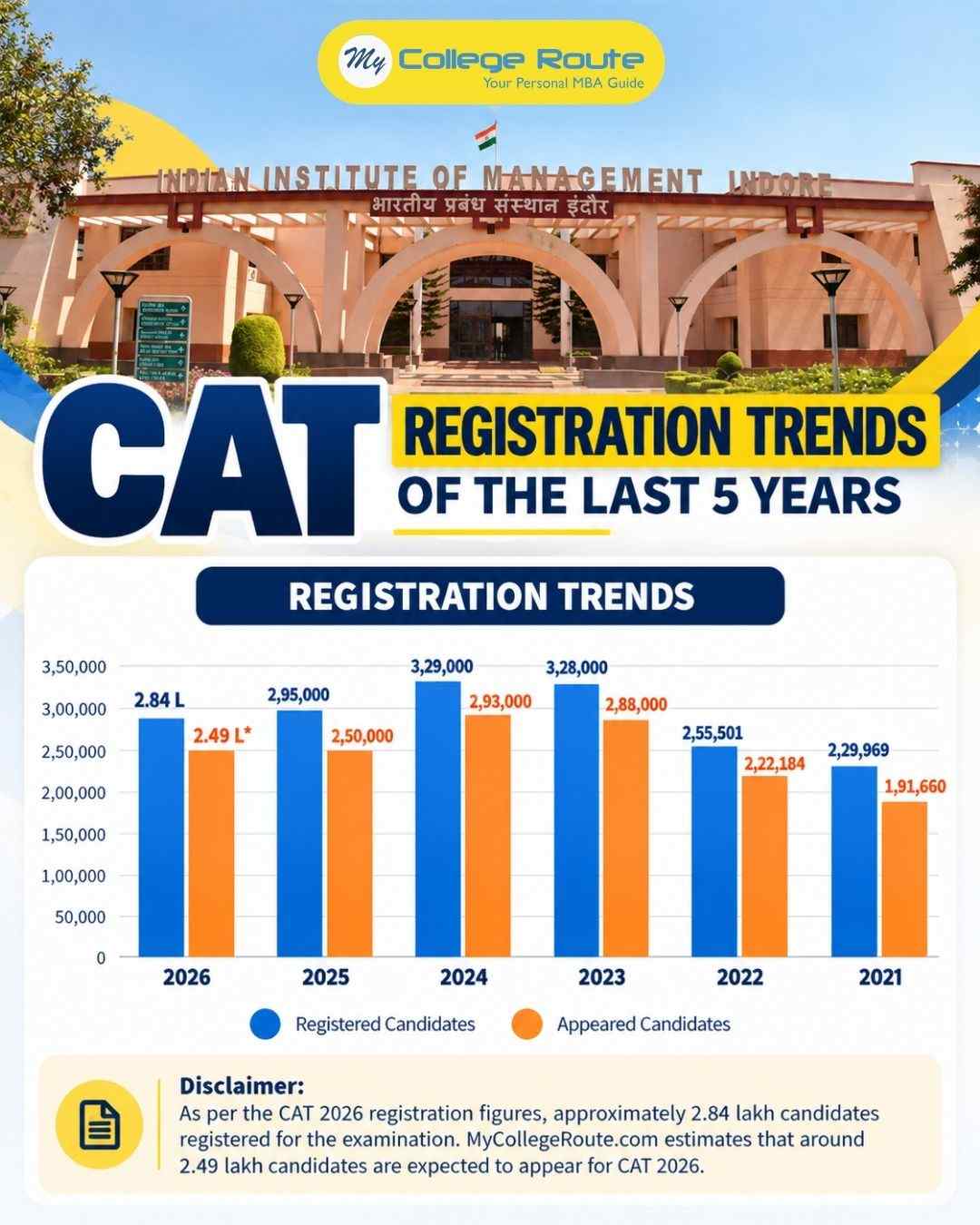
CAT 2026 has recorded approximately 2.84 lakh registrations, once again demonstrating the strong interest in management education among Indian graduates and working professionals. However, the number also raises an important question: Is competition for MBA admissions increasing, or are aspirants becoming more selective about management entrance examinations?
A closer look at the CAT registration trends from 2021 to 2026 reveals an interesting pattern. Registrations increased significantly between 2021 and 2024, reached approximately 3.29 lakh in 2024, and subsequently declined to 2.95 lakh in 2025 and 2.84 lakh in 2026.
With IIM Indore conducting CAT 2026, students are also curious about whether the paper will become more difficult, whether particular sections will carry greater weight, and what they should expect on examination day.
But the smarter approach is simple:
Don't predict the paper. Understand the philosophy behind CAT.
Rather than trying to guess the exact difficulty level or question distribution, aspirants should understand what CAT measures: conceptual clarity, analytical reasoning, reading ability, problem-solving efficiency and decision-making under time constraints.
This article examines the last five years of CAT registration data, the expected attendance for CAT 2026, competition trends, preparation strategies and MBA admission opportunities across India.
CAT Registration Trends 2021–2026: Complete Data
Understanding CAT registration trends helps students separate actual competition from perceived competition.
The following table presents the historical candidate data along with the 2026 attendance projection.
| CAT Year | Registered Candidates | Appeared Candidates |
|---|---|---|
| 2026 | Approx. 2,84,000 | Approx. 2,49,000* |
| 2025 | Approx. 2,95,000 | Approx. 2,58,000 |
| 2024 | Approx. 3,29,000 | Approx. 2,93,000 |
| 2023 | Approx. 3,28,000 | Approx. 2,88,000 |
| 2022 | 2,55,501 | 2,22,184 |
| 2021 | 2,29,969 | 1,91,660 |
CAT 2026 attendance is an estimate by My College Route, not the actual number of candidates appearing. CAT 2025 attendance has been updated from the infographic's earlier approximation to the approximately 2.58 lakh candidates reported after the examination.
What does the data reveal?
Three important patterns emerge:
-
CAT registrations increased rapidly between 2021 and 2024.
-
Registration numbers declined in 2025 and 2026.
-
Actual attendance has consistently remained lower than the total number of registrations.
The data also indicates that CAT competition cannot be measured only through the total number of registered candidates.
CAT 2026 Registration: How Many Candidates Applied?
Approximately 2.84 lakh candidates registered for CAT 2026, compared with 2.95 lakh registrations in 2025.
This represents a decline of roughly 3.7% in registrations.
Key CAT 2026 highlights
-
Conducting Institute: IIM Indore
-
Examination: Common Admission Test 2026
-
Exam Date: 29 November 2026
-
Registered Candidates: Approximately 2.84 lakh
-
Expected Appeared Candidates: Approximately 2.49 lakh, according to My College Route's projection
-
Purpose: Admission to IIMs and participating MBA/PGDM institutions
Why is CAT 2026 registration lower than CAT 2025?
The available registration data confirms the decline, but it does not independently establish the reasons.
Possible contributing factors include:
-
Students applying more selectively to entrance examinations.
-
Greater awareness of MBA fees and return on investment.
-
Changes in graduate employment opportunities.
-
Aspirants exploring alternative exams or career routes.
-
Candidates evaluating whether an MBA suits their long-term career objectives.
These are possible explanations rather than established causes.
A lower registration count does not automatically mean weaker MBA demand. Nor does it guarantee easier admission to top B-Schools.
CAT Registration Analysis: 2021 to 2026
CAT 2021: The Starting Point
CAT 2021 recorded 2,29,969 registrations, with 1,91,660 candidates appearing for the examination.
The figures provide a useful baseline for understanding how candidate participation evolved over subsequent years.
CAT 2022: Strong Growth in Participation
In 2022, registrations increased to 2,55,501, while 2,22,184 candidates appeared.
This indicates a noticeable expansion in the number of aspirants entering the CAT examination process.
CAT 2023: A Major Jump
CAT 2023 witnessed approximately 3.28 lakh registrations and 2.88 lakh actual test-takers.
This substantial increase marked a period of high participation in the MBA entrance examination ecosystem.
CAT 2024: Registrations Remained Near the Peak
CAT 2024 recorded approximately 3.29 lakh registered candidates, with around 2.93 lakh appearing for the examination.
The year represented the highest registration figure in the 2021–2026 period covered in this analysis.
CAT 2025: Registrations Declined
CAT 2025 recorded approximately 2.95 lakh registrations and 2.58 lakh actual test-takers.
Although registrations declined compared with 2024, participation remained substantially higher than in 2021 and 2022.
CAT 2026: A More Moderate Registration Cycle
CAT 2026 recorded approximately 2.84 lakh registrations.
My College Route estimates that around 2.49 lakh candidates may appear for the examination, although the actual attendance will only be established after the test.
The registration figures suggest a moderation from the 2023–2024 peak, not the disappearance of competitive demand for leading management institutes.
CAT 2026 Expected Attendance: How Many Candidates May Appear?
Not every candidate who registers for CAT eventually appears for the examination.
Historical data shows that registration and attendance are two different measures.
Why do some registered candidates miss CAT?
Possible reasons include:
-
Health or personal circumstances
-
Scheduling conflicts
-
Changes in career plans
-
Incomplete preparation
-
Travel difficulties
-
Decisions to pursue other entrance examinations
These factors explain why registered candidates and actual test-takers should be considered separately.
My College Route's CAT 2026 attendance estimate
Based on the infographic, My College Route estimates approximately 2.49 lakh CAT 2026 test-takers.
If that estimate materializes, it would represent attendance of roughly 88% of registered candidates.
This figure remains a forecast. It should not be presented as official CAT 2026 attendance until the examination is conducted.
Will Lower CAT 2026 Registrations Reduce Competition?
This is one of the most important questions for CAT aspirants.
The answer is: Not necessarily.
A decline in registrations may reduce the overall candidate pool, but admission to leading B-Schools depends on several additional factors.
These include:
-
Performance of other candidates
-
Score distribution
-
Sectional performance
-
Reservation category
-
Academic background
-
Academic consistency
-
Work experience
-
Institute-specific selection criteria
-
Personal interview performance
A smaller candidate pool does not automatically mean easier questions, higher percentiles or lower admission cutoffs.
What should students understand?
Competition for a place at IIM Ahmedabad, IIM Bangalore, IIM Calcutta, IIM Lucknow or other leading institutions depends on much more than registration numbers.
An aspirant's final admission prospects are determined by their score and overall profile relative to the specific institute's selection process.
Therefore, the right preparation strategy should remain focused on individual performance improvement.
CAT 2026 and IIM Indore: Don't Predict the Paper, Understand the Philosophy
With IIM Indore conducting CAT 2026, several aspirants are looking at previous examinations conducted by the institute and attempting to predict the upcoming question paper.
However, historical patterns cannot establish what the 2026 paper will contain.
The CAT examination aims to evaluate a candidate's ability to process information, interpret complex problems and make effective decisions within limited time.
The organizing institute's identity alone should not be treated as evidence that the examination will follow a particular difficulty pattern.
What is the underlying philosophy of CAT?
CAT is not simply a test of memorized formulas or vocabulary.
It broadly evaluates three capabilities:
-
Verbal and Reading Ability: Can you understand, interpret and critically evaluate written information?
-
Data Interpretation and Logical Reasoning: Can you identify relationships and solve unfamiliar problems logically?
-
Quantitative Ability: Can you apply mathematical concepts efficiently and accurately?
A strong CAT performance requires a combination of understanding, accuracy, speed and question selection.
Why Predicting CAT 2026 Difficulty Can Be Misleading
Students often try to predict:
-
Whether VARC will be difficult
-
Whether DILR will have unusual sets
-
Whether Quantitative Ability will focus heavily on algebra
-
Whether arithmetic will dominate the paper
-
Whether the overall examination will be harder than CAT 2025
While analysing past papers can help identify recurring concepts, it cannot reliably predict the next examination.
Why does this matter?
Aspirants who prepare exclusively for a predicted pattern risk becoming uncomfortable when the actual paper differs from their expectations.
Instead, CAT 2026 preparation should emphasize adaptability.
A strong candidate should be able to:
-
Handle unfamiliar questions.
-
Recognize solvable problems quickly.
-
Avoid time-consuming traps.
-
Maintain accuracy.
-
Move between difficulty levels.
-
Adapt strategy without panicking.
The most effective CAT strategy is preparation for uncertainty, not prediction of certainty.
How to Prepare for CAT 2026 Using a Concept-First Strategy
Students should structure their preparation around the three major CAT sections.
1. VARC: Verbal Ability and Reading Comprehension
VARC requires reading accuracy, comprehension and logical interpretation.
Students should focus on:
-
Reading comprehension practice
-
Identifying central arguments
-
Understanding author tone
-
Evaluating inferences
-
Paraphrasing
-
Paragraph organization
-
Eliminating incorrect answer choices
Preparation tip: Read regularly and analyse why each answer option is correct or incorrect.
2. DILR: Data Interpretation and Logical Reasoning
DILR tests the ability to organize information and solve logical problems.
Students should practice:
-
Arrangements
-
Scheduling problems
-
Tables and charts
-
Games and tournaments
-
Distribution-based sets
-
Logical constraints
-
Caselet interpretation
-
Quantitative reasoning sets
Preparation tip: Develop strong set-selection ability instead of attempting every set.
3. QA: Quantitative Ability
Quantitative Ability requires mathematical understanding and efficient problem-solving.
Important areas include:
-
Arithmetic
-
Algebra
-
Geometry
-
Number systems
-
Modern mathematics
Preparation tip: Focus on conceptual clarity, calculation efficiency and choosing questions according to your strengths.
How CAT Mock Tests Help More Than Paper Predictions
Mock tests are among the most valuable preparation resources for CAT aspirants.
But taking many mocks without reviewing them is not an effective strategy.
After every CAT mock, analyse:
-
Conceptual Gaps: Which questions could you not solve because you did not understand the concept?
-
Accuracy: Where did incorrect calculations or misinterpretations affect your score?
-
Time Management: Which questions consumed more time than expected?
-
Question Selection: Did you skip easier questions while attempting difficult ones?
-
Sectional Performance: Which section requires greater attention?
A reliable improvement cycle is:
Attempt Mock → Analyse Performance → Identify Mistakes → Revise Concepts → Attempt Again
Your mock score is a diagnostic measure, not a prediction of your final CAT performance.
What Does CAT Registration Data Mean for Percentiles?
One common misunderstanding among aspirants is that a lower number of registered candidates will automatically improve their percentile.
CAT percentile represents relative performance among candidates appearing for the examination.
What influences percentile?
Percentile is affected by:
-
Number of candidates appearing
-
Relative performance
-
Score distribution
-
Difficulty differences across slots
-
The applicable normalization process
For example, being among the highest-performing candidates matters more than the registration number itself.
Students should therefore avoid predicting their percentile using registration figures alone.
Instead, aspirants should use mock scores, comparative performance data and score-versus-percentile analysis cautiously.
How to Build a CAT 2026 MBA College Shortlist
CAT preparation should run alongside MBA application planning.
Aspirants should not wait until the result is announced before researching their preferred institutions.
A practical MBA college shortlist should include three categories.
Dream Colleges
Institutions where admission is highly competitive but worth pursuing because of their academic reputation, placement outcomes and career opportunities.
Examples may include leading IIMs, FMS Delhi and other highly selective B-Schools.
Target Colleges
Institutes where a student's expected CAT performance, academic profile and career goals are reasonably aligned with the admission criteria.
Safe Colleges
Institutes offering a relatively stronger probability of selection based on the student's expected performance, profile and financial preferences.
However, no B-School can be considered guaranteed admission.
What factors should students compare?
-
Expected CAT percentile
-
Sectional cutoffs
-
Academic eligibility
-
Programme specialization
-
Total fees
-
Average and median placements
-
Recruiter diversity
-
Alumni network
-
Location
-
Return on investment
-
Selection process
A balanced shortlist reduces dependence on a single institute or admission outcome.
How My College Route Helps CAT 2026 Aspirants
My College Route helps students connect CAT preparation with informed MBA admission decisions.
Aspirants can use the platform to explore:
-
CAT 2026 registration updates
-
Exam preparation insights
-
CAT score and percentile guidance
-
MBA College Predictor
-
Compare MBA and PGDM Colleges
-
CAT-accepting institutes
-
City-wise MBA colleges
-
MBA fee comparisons
-
Placement and ROI insights
-
B-School application deadlines
The goal is to help students move from exam preparation to a more informed college shortlist.
Key Takeaways: CAT 2026 Registration Trends
The registration figures highlight several important lessons.
-
Approximately 2.84 lakh candidates registered for CAT 2026.
-
Registrations have declined from the peak recorded in 2024.
-
CAT 2025 recorded approximately 2.95 lakh registrations and 2.58 lakh actual appearances.
-
My College Route estimates approximately 2.49 lakh test-takers for CAT 2026.
-
Lower registrations do not automatically mean lower difficulty or easier admission.
-
IIM Indore is conducting CAT 2026, but that does not establish a predictable question-paper pattern.
-
CAT aspirants should focus on conceptual clarity, mock analysis and question selection.
-
MBA college shortlisting should begin before the CAT result.
Conclusion
CAT 2026 registration trends reveal how MBA entrance examination participation has evolved over the past several years.
From 2.30 lakh registrations in 2021 to approximately 3.29 lakh in 2024 and 2.84 lakh in 2026, the figures highlight both expansion and moderation in candidate participation.
However, aspirants should not confuse a decline in registrations with a guaranteed reduction in competition at leading MBA institutions.
Similarly, the fact that IIM Indore is conducting CAT 2026 should not encourage students to predict the examination solely from historical organizing-institute patterns.
The most effective preparation approach remains consistent: understand concepts, practise regularly, analyse mocks, develop adaptability and make thoughtful question-selection decisions.
For students targeting MBA admission 2027, preparation should also include comparing colleges by expected percentile, fees, placements, specializations and location.
Don't spend your remaining preparation time guessing what CAT 2026 will look like. Build the skills needed to handle whatever appears on examination day.
Frequently Asked Questions About CAT 2026 Registration Trends
1. How many candidates registered for CAT 2026?
Approximately 2.84 lakh candidates registered for CAT 2026.
2. How many candidates are expected to appear for CAT 2026?
My College Route estimates that approximately 2.49 lakh candidates may appear. This is a projection, not official attendance data.
3. Which institute is conducting CAT 2026?
IIM Indore is conducting CAT 2026.
4. When is CAT 2026 scheduled?
CAT 2026 is scheduled for 29 November 2026.
5. What was the highest CAT registration figure between 2021 and 2026?
CAT 2024 recorded approximately 3.29 lakh registrations, the highest figure in the period covered.
6. How many students appeared for CAT 2025?
Approximately 2.58 lakh candidates appeared for CAT 2025 out of 2.95 lakh registrations.
7. Why did CAT 2026 registrations decline?
Registrations decreased by approximately 3.7% compared with 2025. The registration figures alone do not establish the exact reasons.
8. Does lower CAT registration mean an easier paper?
No. Registration numbers cannot determine the difficulty level of the question paper.
9. Will IIM Indore make CAT 2026 difficult?
There is no reliable basis to conclude that IIM Indore will make CAT 2026 easier or harder simply because it is conducting the exam.
10. Can students predict CAT 2026 using previous papers?
Previous papers can reveal useful concepts and question types, but cannot reliably predict the exact examination pattern or difficulty.
11. What are the main sections in CAT?
The main sections are Verbal Ability and Reading Comprehension, Data Interpretation and Logical Reasoning, and Quantitative Ability.
12. How should students improve CAT mock scores?
Students should review conceptual errors, accuracy, time management and question selection after every mock test.
13. Does a lower candidate count improve CAT percentile?
Not automatically. Percentile depends on performance relative to other test-takers and the applicable scoring and normalization processes.
14. Which MBA colleges accept CAT scores?
CAT is used by IIMs and multiple non-IIM B-Schools, including FMS Delhi, MDI Gurgaon, SPJIMR Mumbai and various IIT management departments, subject to programme-specific requirements.
15. How can My College Route help with MBA admission 2027?
My College Route helps aspirants explore CAT-based admission options, predict suitable colleges, compare fees and placements, and follow B-School application deadlines.
© 2026 mycollegeroute.com All Rights Reserved. Website designed by Orbit Inhouse