SPJIMR Mumbai: Different Management Programmes for Different Career Journeys
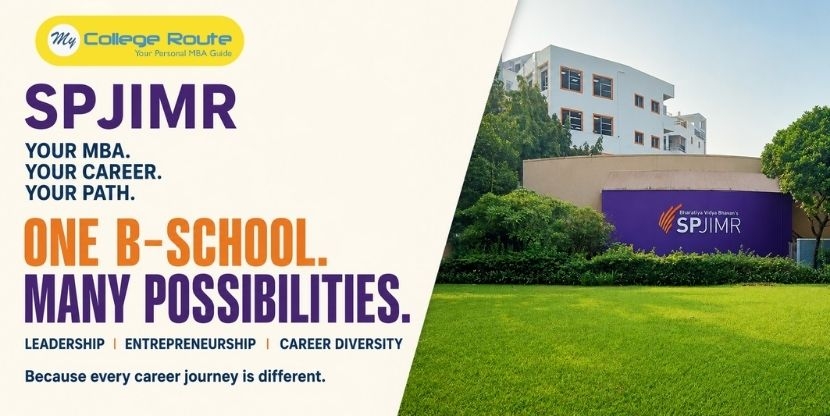
What If One Business School Refused to Believe That Every Manager Should Learn the Same Way? Now Imagine four people arriving on the same campus.
The first has just graduated from college and wants to build a career in management. The second has spent nearly a decade working in the corporate world and is ready for larger leadership responsibilities. The third is preparing to take over a family business built over generations. The fourth has an entrepreneurial idea but isn't sure how to transform it into a sustainable business.
All of them want to become better business leaders.
But should they really sit in the same classroom, study the same curriculum, and expect the same outcome?
For decades, that was largely how management education worked. A single programme was expected to prepare learners with completely different ambitions, professional experiences, and career aspirations. It was an efficient model, but not always the most relevant one.
SPJIMR chose to look at the question differently.
Instead of asking how many management programmes a business school should offer, it began with a simpler question: What does this learner actually need at this stage of their career? The answer naturally led to an academic portfolio that looks very different from what many business schools have traditionally built.
That difference becomes visible long before you compare brochures or programme structures.
A student entering management education immediately after graduation is trying to understand how organisations function. They need exposure to finance, marketing, operations, strategy, economics, analytics, organisational behaviour, and the fundamentals of business decision-making. For such learners, SPJIMR's Post Graduate Diploma in Management (PGDM) provides a comprehensive foundation while encouraging students to think beyond textbooks through experiential learning, industry engagement, global exposure, and value-based education.
Now consider someone who already has several years of professional experience.
Their questions are rarely about understanding what marketing or finance means. They have already worked with teams, clients, targets, and organisational challenges. What they often seek is perspective—how to make better strategic decisions, lead larger teams, navigate uncertainty, and prepare for responsibilities that extend beyond functional expertise. Programmes such as the Post Graduate Programme in Management (PGPM) and the Post Graduate Executive Management Programme (PGEMP) are designed around those realities. Rather than asking experienced professionals to repeat what they already know, they encourage them to build on the experience they already bring into the classroom.
The picture changes once again when the learner belongs to a business family.
Managing a family enterprise involves questions that are rarely discussed in a conventional MBA classroom. Succession planning, governance, family dynamics, long-term stewardship, professionalisation, and balancing legacy with innovation require a different kind of learning. Treating those challenges as just another management elective would ignore their complexity. SPJIMR acknowledges this through its Post Graduate Programme in Family Managed Business (PGPFMB), recognising that leading a family enterprise is a distinct journey that deserves its own academic approach.
Entrepreneurs face a different reality altogether.
Building a business from scratch demands constant experimentation. Decisions often have to be made with limited information, changing markets, and evolving customer expectations. For aspiring founders, management education cannot simply be about analysing existing organisations; it must also encourage the ability to create something new. SPJIMR's entrepreneurial initiatives and learning opportunities reflect that mindset, supporting individuals who aspire to build businesses rather than only manage them.
This philosophy of designing learning around people instead of fitting people into a single programme is perhaps what gives SPJIMR its distinct identity.
Interestingly, despite serving learners at different stages of their careers, the institute's programmes are connected by a common thread. Whether participants are fresh graduates, experienced professionals, entrepreneurs, family business successors, or senior executives, the emphasis consistently remains on reflective learning, responsible leadership, practical application, and understanding the wider impact of managerial decisions. The destination may differ, but the educational philosophy remains remarkably consistent.
That philosophy also explains why learning at SPJIMR rarely remains confined to classroom discussions.
Students engage with industry, work on live business challenges, interact with practitioners, participate in global learning opportunities, and experience initiatives that encourage them to understand business within a broader social context. Leadership is viewed not merely as the ability to deliver financial results but also as the ability to understand people, communities, and the consequences of business decisions. It is this combination of academic learning and experiential exposure that gives the institute's programmes their distinctive character.
The institute's academic landscape extends even further through Executive Education, specialised learning opportunities for working professionals, doctoral and fellow programmes that contribute to management research, and initiatives that encourage continuous learning throughout a professional's career. Collectively, these offerings reflect an important idea: management education is not a single milestone achieved in one's twenties; it is a process that evolves as careers evolve.
Perhaps that is why SPJIMR is often difficult to describe through a single programme.
Many business schools are identified primarily by their flagship MBA. SPJIMR certainly has a highly regarded PGDM, but its identity has gradually grown around something larger-the belief that management education should recognise the diversity of people who seek it. Instead of expecting everyone to adapt to one learning model, the institute has spent decades building different pathways for different ambitions.
That perspective feels increasingly relevant today.
Careers are no longer linear. A graduate may become an entrepreneur. An engineer may move into consulting. A corporate executive may return to manage a family enterprise. Someone leading a successful business may decide to pursue formal management education after years of professional experience. When career journeys become so varied, expecting one programme to address every aspiration begins to seem increasingly unrealistic.
Choosing a business school, therefore, is no longer only about asking which institute has the highest ranking or the biggest placement package. It is equally about understanding which learning journey reflects where you are today and where you hope to be tomorrow.
That is where My College Route helps aspirants make more informed decisions. Rather than simply comparing institutions, it enables students and professionals to understand the philosophy behind different programmes, identify which learning pathway aligns with their career stage, and evaluate management education through a broader lens than rankings alone.
Perhaps that is SPJIMR's most distinctive contribution to management education. It reminds us that becoming a better manager does not always begin with finding the best programme. Sometimes, it begins with finding the programme that understands your journey. And in a world where careers are becoming increasingly diverse, that may be one of the most valuable lessons a business school can offer.
© 2026 mycollegeroute.com All Rights Reserved. Website designed by Orbit Inhouse