MDI Gurgaon PGDM: How Learning Goes Beyond the Classroom
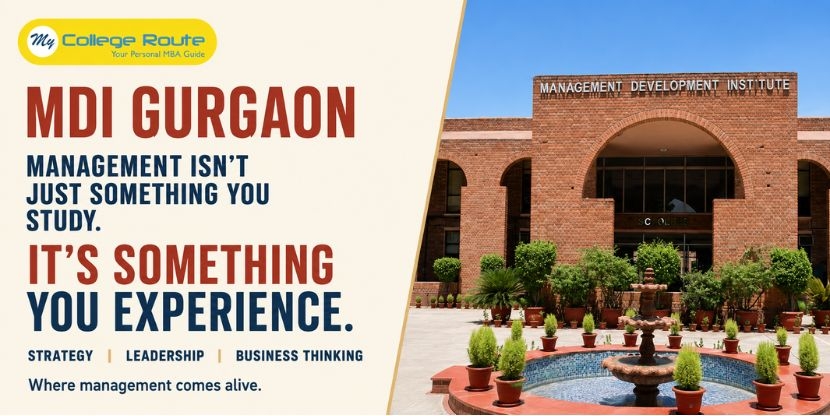
The Best Management Lessons at MDI Gurgaon's PGDM Don't Come With a Course Code & there is a moment in almost every MBA student's journey when the classroom quietly stops being the centre of learning.
It may happen while organising a management convention with industry leaders waiting backstage. It may happen during a case competition where every team believes it has the winning strategy until the judges ask one unexpected question. Sometimes it begins during a late-night discussion with classmates who see the same business problem through completely different lenses because they come from different industries, cities, and academic backgrounds.
That shift-from studying management to actually experiencing it-is what defines the flagship Post Graduate Diploma in Management (PGDM) at MDI Gurgaon.
It would be easy to describe the programme through its curriculum. Like every leading management institute, MDI introduces students to finance, marketing, operations, economics, strategy, organisational behaviour, analytics, and the many disciplines expected of a contemporary management programme. Those subjects form the academic foundation of the two-year PGDM and continue to evolve alongside changing business realities. But stopping there would explain only one part of the story.
The other part begins the moment students step outside the classroom.
Walk around the MDI Gurgaon campus on an ordinary weekday and it quickly becomes clear that learning follows no fixed timetable. One group is preparing for a national case competition. Another is inviting industry leaders for a management conclave. A student committee is coordinating logistics for a campus event while an academic club debates the latest developments in finance, marketing, technology, or strategy. Across the campus, someone is rehearsing for a cultural performance, while another team is planning a TEDx event. None of these experiences appear as individual subjects in the syllabus, yet each demands planning, teamwork, negotiation, leadership, communication, and decision-making-the very qualities management education hopes to cultivate.
This is perhaps why MDI Gurgaon has always viewed student life as an extension of the classroom rather than an escape from it. Academic clubs encourage students to deepen their understanding of different management domains, while activity clubs and student interest groups provide opportunities to explore interests that stretch beyond business education. Whether it is entrepreneurship, finance, consulting, public speaking, literature, technology, social initiatives, podcasts, or creative pursuits, students are encouraged to participate, experiment, and contribute. Learning here is rarely confined to lecture halls because curiosity itself becomes part of the educational experience.
The institute's annual calendar reflects the same philosophy. Events such as Imperium, Delphique, Illumina, and TEDxMDIGurgaon, along with conferences, seminars, leadership interactions, and business competitions, are much more than campus traditions. Students take responsibility for conceptualising ideas, coordinating teams, managing sponsorships, engaging with speakers, handling logistics, solving last-minute challenges, and ensuring that every event comes together successfully. In the process, they develop practical judgement that no examination can fully evaluate.
Every one of these experiences complements the learning philosophy of MDI Gurgaon's flagship PGDM, where management is understood not merely as an academic discipline but as something that becomes meaningful only when it is practised. The classroom introduces concepts; the campus repeatedly creates situations where those concepts must be applied.
Location further strengthens this learning environment.
Situated in Gurugram, one of India's most significant corporate centres, MDI benefits from an ecosystem where business conversations rarely remain confined to textbooks. Corporate leaders regularly visit the campus for guest lectures, conferences, recruitment interactions, panel discussions, and knowledge-sharing sessions. Students also find themselves surrounded by organisations across consulting, technology, financial services, manufacturing, consumer businesses, and emerging sectors. The city itself becomes a living laboratory where classroom discussions often find immediate relevance.
The learning experience is equally influenced by the institute's academic culture. Faculty members remain actively engaged in research, publications, conferences, consultancy, and contemporary business discussions, ensuring that students engage with ideas that extend beyond established theories. MDI's global collaborations and international engagements further expose students to different academic systems and business perspectives, encouraging them to understand management within a broader global context rather than through a single market or industry.
Another strength of the PGDM programme lies in the people who become part of the learning journey. Every batch brings together individuals from diverse academic backgrounds, industries, work experiences, and regions of the country. A classroom discussion on pricing, consumer behaviour, organisational change, or business strategy rarely ends with one universally accepted answer because every participant approaches the problem differently. Those differences often become the most valuable source of learning. Students gradually discover that effective managers are not defined by always having the right answer but by their ability to listen, question assumptions, evaluate alternatives, and make informed decisions amid uncertainty.
Over the years, MDI Gurgaon has expanded its academic portfolio to include specialised programmes in Business Analytics, Human Resource Management, Banking & Financial Services, International Business, Online Management, executive education, and doctoral research. Even so, the flagship PGDM continues to remain at the heart of the institute's identity. It reflects the philosophy that has shaped MDI's reputation over the decades—combining intellectual depth with practical exposure while encouraging students to grow through participation as much as through academic achievement.
It is perhaps this balanced approach that continues to earn the confidence of recruiters across industries. Employers certainly value technical competence and academic performance, but they also look for professionals who can communicate with clarity, collaborate across diverse teams, adapt to changing situations, and remain composed while solving complex problems. Much of that confidence is built not during examinations but through the responsibilities, experiences, and interactions students accumulate throughout their two years at MDI.
Choosing a management programme, therefore, is rarely about comparing subjects or placement statistics alone. It is about finding an institution whose learning philosophy aligns with the kind of professional one hopes to become. The culture surrounding a programme often shapes students just as much as the curriculum itself.
That is where My College Route encourages aspirants to look beyond rankings and brochures. Instead of reducing business schools to numbers, the platform helps students understand how different institutions approach management education, what kind of campus environment they create, the opportunities available beyond academics, and how those experiences contribute to long-term professional growth. Looking at management education through that wider lens often leads to more informed decisions.
Perhaps that is why MDI Gurgaon's flagship PGDM continues to command respect year after year. Long after students forget individual lectures or specific case studies, they carry forward the judgement, confidence, relationships, and perspective they developed during those two years. In the end, those are the lessons that shape careers-and they rarely come with a course code.
© 2026 mycollegeroute.com All Rights Reserved. Website designed by Orbit Inhouse