IMS Ghaziabad PGDM: Curriculum, Specialisations, Industry Exposure & Placements
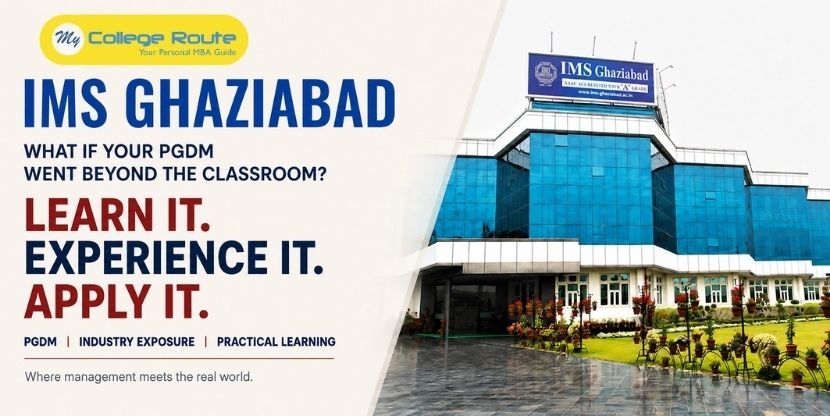
A PGDM That Moves With the Student: Understanding the IMS Ghaziabad Approach to Management Education
What does a student actually need from a management programme?
The obvious answers are easy: good faculty, industry exposure, specialisations, internships and a degree that can open doors. But anyone who has spent enough time around management education knows that these things, by themselves, do not tell the whole story. Two colleges can offer almost the same list of features and still give students very different experiences.
The difference often lies in what happens between the brochure points.
At Institute of Management Studies Ghaziabad (IMS Ghaziabad), the PGDM is structured as a two-year journey in which students gradually move from understanding business fundamentals to working with them in more practical settings. The programme is approved by AICTE, recognised by AIU as equivalent to an MBA, and accredited by NBA. It follows a trimester structure, with students moving through different stages of the curriculum before entering their specialisation areas.
That structure matters because nobody enters a management classroom as a finished manager.
A fresh graduate may know economics, accounts or marketing from college, but may have little idea of how those subjects come together inside an organisation. The first job of a PGDM programme, therefore, is not to turn students into specialists overnight. It is to give them enough understanding of business to start seeing the connections.
At IMS Ghaziabad, the programme then gives students the opportunity to take that understanding in a more specific direction through dual specialisations. The current options include Applied AI, Finance, Human Resource, Marketing and Operations.
The inclusion of Applied AI alongside more traditional management functions is particularly telling.
Business has changed considerably in the last few years. Data is part of marketing. Automation is changing operations. Financial decisions increasingly depend on technology. HR teams work with workforce analytics and digital platforms. A management student does not necessarily need to become a programmer, but understanding the tools shaping business has become increasingly difficult to ignore.
That is why exposure to Advanced MS Excel, Power BI, Tableau and Python within the institute's data-literacy initiatives is worth noticing. These are practical tools, not merely topics to be discussed in a management textbook.
But technology is only one side of becoming management-ready.
There is also the less glamorous stuff that eventually makes a difference at work: speaking clearly, working with people, presenting an idea, listening to another point of view, handling a team assignment and figuring out what to do when the problem in front of you does not have four neatly written options.
IMS Ghaziabad's learning ecosystem includes student peer learning, mentoring, competency mapping, public speaking modules, a language lab, corporate immersion and domain-specific skill-building initiatives. It also has entrepreneurship initiatives through its Centre for Innovation & Entrepreneurship.
These details can sound ordinary when listed separately. They become more meaningful when you consider what a management student is actually being prepared for.
Nobody hires a graduate because they can reproduce a definition of leadership. They hire them because they can eventually handle a meeting, understand a problem, work with colleagues, analyse information and make a reasonably sound decision.
That shift-from knowing to doing-is where the IMS Ghaziabad PGDM becomes more interesting.
The programme includes a compulsory 6-8 week summer internship after the first three trimesters. Students then return for the second year, where they continue with their dual specialisations and complete a compulsory dissertation project.
There is a certain logic to that sequence.
Students spend the initial part of the programme learning the language of business. Then they enter an organisation and discover that the language does not always translate as neatly as it did in class. Priorities change. People behave unpredictably. Information is incomplete. Deadlines are real. A project has to be delivered, not simply submitted.
That experience can change the way a student looks at the second year.
The dissertation that follows is another opportunity to go deeper into a chosen area rather than simply moving from one examination to another. It gives students a chance to work with a more focused question and approach it with greater independence.
For students comparing a PGDM college in Ghaziabad with other options in Delhi NCR, these stages are worth examining because they tell you more about the actual student journey than a long list of facilities ever can.
The corporate connection is another part of that journey.
IMS Ghaziabad's current placement information reports 185+ companies visited, with a Rs.43 lakh highest salary and Rs.9.5 lakh median salary in its latest placement report. The institute also reports participation from companies across sectors including FMCG/FMCD, consulting, banking, IT and services, NBFC, logistics, retail, manufacturing and automobile, and e-learning.
Those figures will naturally catch an aspirant's attention. They should. But placement numbers are only one part of the decision.
A student spends two years preparing for that final transition. So the better question is what happens before recruitment begins. How much industry exposure is available? What kind of internship is built into the programme? Are students given opportunities to develop communication and analytical skills? Do they get exposure to tools that are actually being used in organisations?
This is where the wider management education ecosystem at IMS Ghaziabad becomes relevant.
The institute says it has been in management education for 36 years, and its current institutional credentials include AICTE approval, NBA accreditation, AIU equivalence, AACSB membership, Business Graduates Association membership, ASIC accreditation and ISO certification.
But longevity, by itself, is not a reason to choose a business school.
What matters more is whether an old institution keeps making room for new realities.
The presence of Applied AI, data-literacy initiatives, entrepreneurship activities, corporate immersion and industry-oriented learning suggests that the IMS Ghaziabad PGDM is trying to do exactly that. The fundamentals of management remain important, but the environment in which those fundamentals are used has changed.
And perhaps that is the most useful way to look at the programme.
- Not as a collection of subjects.
- Not even as a two-year qualification.
- But as a gradual shift in the student's role.
At first, you are learning what a business is and how its functions work. Then you begin choosing the areas in which you want to develop greater expertise. You interact with practitioners, work with data, participate in projects and eventually spend time inside an organisation. By the time you reach the dissertation and placement stage, the expectation is no longer simply that you know the concepts. You should have some experience of using them.
For someone searching for the best PGDM college in Delhi NCR, that is a useful distinction to keep in mind.
There is no shortage of management institutes competing for the attention of MBA and PGDM aspirants. Brochures will inevitably mention placements, faculty, infrastructure, industry interaction and specialisations. The harder-and more useful-comparison is to look at how those pieces come together during the two years a student actually spends there.
This is also where My College Route can be useful. Instead of reducing a PGDM college in Delhi NCR to a ranking or a single placement figure, students can compare the elements that shape their experience: curriculum, specialisations, industry exposure, internships, experiential learning, technology exposure and career preparation.
Because the right management programme is not necessarily the one with the longest feature list.
It is the one that moves with the student.
And that is perhaps the most interesting thing about the IMS Ghaziabad PGDM: it begins with the fundamentals, gives students room to find a direction, takes them closer to industry and gradually asks them to take greater ownership of their learning.
For a management student, that progression may matter more than any brochure headline.
© 2026 mycollegeroute.com All Rights Reserved. Website designed by Orbit Inhouse