CAT 2026 Last-Minute Preparation: Exam-Day Strategies & Tips
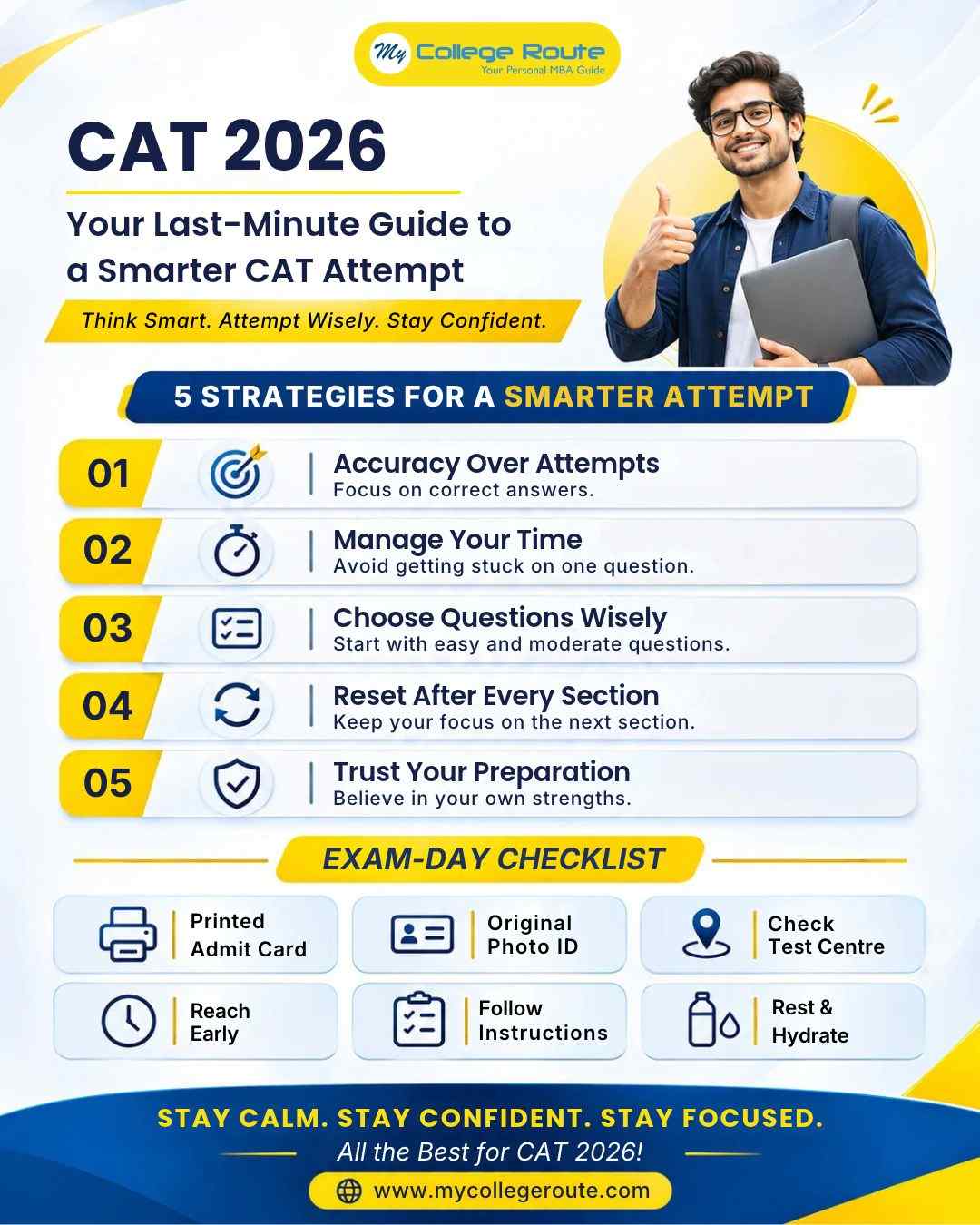
CAT 2026 is scheduled for 29 November 2026, and thousands of MBA aspirants are preparing to take one of India's most competitive management entrance examinations. With IIM Indore conducting the Common Admission Test this year, students are closely following examination updates, last-minute preparation strategies, admit card instructions, and exam-day guidelines.
At this stage, the biggest challenge is no longer completing the entire syllabus. It is understanding how to use your preparation effectively within the examination's time constraints.
Many CAT aspirants make the mistake of attempting too many questions, spending excessive time on difficult problems, or allowing one challenging section to affect their performance in the remaining sections.
However, a smarter CAT attempt is not necessarily the one with the highest number of attempted questions. It is the one that balances accuracy, time management, question selection, and composure.
Think Smart. Attempt Wisely. Stay Confident.
This should be the guiding principle for CAT 2026 aspirants.
The five important strategies for a smarter CAT attempt are:
- Accuracy over attempts
- Manage your time
- Choose questions wisely
- Reset after every section
- Trust your preparation
Along with these strategies, students must prepare an exam-day checklist, verify their test-center location, and follow the instructions issued by the conducting authority.
This article provides a practical last-minute CAT 2026 preparation guide covering exam-day strategy, VARC, DILR and QA tips, IIM Indore's examination philosophy, common mistakes, MBA admission planning and city-wise college discovery.
CAT 2026 Exam Overview: Important Details
Before planning the final examination strategy, students should understand the essential CAT 2026 details.
|
Particular |
Details |
|
Examination |
Common Admission Test (CAT) 2026 |
|
Conducting Institute |
IIM Indore |
|
Exam Date |
29 November 2026 |
|
Examination Mode |
Computer-Based Test |
|
Sessions |
Three |
|
Main Sections |
VARC, DILR and QA |
|
Official Website |
iimcat.ac.in |
|
Admit Card |
Available through candidate login |
|
MBA Admission Cycle |
2027–29 |
Candidates must check their individual admit cards for the allotted examination session, reporting time, gate-closing time, and test-center address.
Why Last-Minute CAT 2026 Strategy Matters
CAT is an aptitude examination where success depends on more than subject knowledge.
Two candidates may have similar conceptual understanding but perform differently because of their ability to select questions, avoid errors, and manage examination pressure.
For example, a candidate who spends too long solving one difficult question may miss several easier opportunities.
Similarly, attempting questions without adequate confidence can affect overall accuracy.
What should students focus on before CAT 2026?
During the final preparation stage, aspirants should prioritize:
- Revision of familiar concepts
- Question-selection strategy
- Maintaining accuracy
- Reviewing previous mock-test mistakes
- Time management
- Understanding the examination interface
- Following official exam-day instructions
- Maintaining adequate rest
- Avoiding unnecessary stress
The objective is to enter the examination with a clear strategy rather than a long list of unfinished topics.
Strategy 1: Accuracy Over Attempts
Accuracy should take priority over attempting the maximum number of questions.
CAT is a competitive examination where incorrect responses to negatively marked questions can reduce the overall score.
Students sometimes believe that attempting more questions automatically increases their percentile.
However, the quality of attempts is equally important.
Why is accuracy important in CAT?
Accuracy helps candidates:
- Reduce avoidable negative marks
- Improve overall scoring efficiency
- Avoid unnecessary guessing
- Manage examination time
- Build confidence during the test
How can students improve accuracy?
A practical approach includes:
- Read each question carefully.
- Identify exactly what is being asked.
- Eliminate clearly incorrect answer choices.
- Avoid making unsupported assumptions.
- Recheck calculations when time permits.
- Skip questions where a reliable solution is unlikely.
- Maintain concentration throughout the section.
Example of accuracy versus attempts
Consider two hypothetical candidates.
Candidate A attempts 25 questions but makes several avoidable errors.
Candidate B attempts fewer questions but answers a much higher proportion correctly.
Depending on the applicable marking scheme, Candidate B may achieve a better score despite attempting fewer questions.
The lesson: Focus on correct answers rather than chasing a predetermined attempt count.
Strategy 2: Manage Your Time Effectively
Time management is one of the most important elements of CAT performance.
Aspirants have limited time to solve questions across VARC, DILR, and QA.
The challenge is not simply to work quickly. It is to decide where your time can produce the greatest benefit.
Why do CAT aspirants lose time?
Common reasons include:
- Spending too long on one question
- Repeatedly checking the same calculation
- Trying to solve every DILR set
- Reading passages without understanding their purpose
- Attempting unfamiliar mathematical problems
- Ignoring the remaining section time
How should students manage their time?
Follow these principles:
- Scan questions before committing excessive time.
- Identify familiar and relatively manageable problems.
- Avoid becoming emotionally attached to one difficult question.
- Monitor the remaining time.
- Prioritize questions with a reasonable probability of being solved correctly.
- Move on when progress stalls.
What is the best time-management strategy?
There is no single time distribution that works for every student.
Some aspirants are stronger in reading comprehension, while others perform better in quantitative reasoning.
The ideal strategy should emerge from previous mock-test experience.
Students should follow a familiar approach on exam day instead of experimenting with an entirely new strategy.
Strategy 3: Choose Questions Wisely
Smart question selection can be more valuable than attempting every question in sequence.
CAT is designed to test reasoning and problem-solving abilities.
Not every question deserves the same amount of time.
Aspirants should identify questions based on familiarity, complexity, and expected solving time.
How can students identify manageable questions?
Look for:
- Familiar concepts
- Clear problem statements
- Straightforward calculations
- Recognizable logical patterns
- Questions with limited working steps
- Passages or sets that are easier to interpret
Which questions should students avoid initially?
Consider postponing questions that involve:
- Lengthy unfamiliar calculations
- Complex logical constraints
- Difficult-to-interpret information
- Repeated unsuccessful attempts
- Excessive time without meaningful progress
Skipping a question is not a failure.
It is a strategic decision that may help preserve time for better opportunities.
Should students begin with easy questions?
Where the interface and section structure allow, beginning with familiar and manageable questions can help develop momentum.
However, students should use the approach they have already practiced successfully in mock tests.
Strategy 4: Reset After Every Section
CAT contains three major sections, and each section presents a separate challenge.
A difficult first section should not determine the candidate's mindset for the entire examination.
Similarly, performing well in one section should not create overconfidence in the next.
Why is resetting important?
Students may lose concentration because they continue thinking about:
- A question they could not solve
- An answer they may have marked incorrectly
- A difficult DILR set
- Their expected percentile
- The performance of other candidates
These thoughts do not help solve the questions in the current section.
How to reset mentally between sections
- Stop evaluating the previous section.
- Focus on the instructions and questions currently displayed.
- Maintain a steady approach.
- Use calm, controlled breathing.
- Avoid estimating your final score during the examination.
- Treat the next section as a fresh opportunity.
A difficult VARC section does not mean DILR or QA will be equally challenging.
Every section deserves your full attention.
Strategy 5: Trust Your Preparation
The final strategy is to trust the work already completed.
By the time CAT 2026 arrives, most aspirants will have spent weeks or months solving practice questions, reviewing concepts, and taking mock tests.
The purpose of that preparation is to develop the ability to handle unfamiliar problems.
Why do students lose confidence before CAT?
Possible reasons include:
- Comparing mock scores with others
- Reading excessive difficulty predictions
- Focusing only on weak areas
- Worrying about college cutoffs
- Overthinking previous examination patterns
- Trying to revise too many new topics
What should students do instead?
Focus on what is within your control:
- Review familiar concepts.
- Remember successful mock-test strategies.
- Avoid unnecessary comparisons.
- Maintain a realistic attempt strategy.
- Prioritize accuracy.
- Get adequate sleep.
- Follow official instructions.
Confidence should come from preparation and a clear plan, not from predicting an easy question paper.
CAT 2026 & IIM Indore Analysis: Don't Predict the Paper, Understand the Philosophy
With IIM Indore conducting CAT 2026, many aspirants are trying to understand whether the examination will resemble previous CAT papers organized by the institute.
However, depending entirely on historical patterns can be misleading.
The identity of the conducting IIM does not provide a reliable prediction of the exact difficulty level or the number of questions from particular topics.
What is the underlying philosophy of CAT?
CAT evaluates whether candidates can:
- Understand written information
- Interpret data
- Recognize logical relationships
- Apply mathematical concepts
- Make decisions under time pressure
- Solve unfamiliar problems
- Balance speed and accuracy
Why should students avoid predicting CAT 2026?
Aspirants cannot know in advance:
- Which VARC passages will appear
- Which DILR set will be easiest
- Whether QA will be relatively difficult
- Which topics will dominate
- How other candidates will perform
Past papers can help students understand broad question types, but they cannot guarantee the next paper.
What should students do instead?
Develop a flexible approach that works across different difficulty levels.
The goal is not to memorize a predicted paper pattern.
The goal is to remain effective even when the actual examination differs from expectations.
CAT 2026 VARC: Last-Minute Strategy
Verbal Ability and Reading Comprehension tests how effectively candidates interpret and evaluate written information.
What should students focus on?
- Reading comprehension
- Central argument identification
- Author's tone
- Inference-based questions
- Logical interpretation
- Verbal reasoning
How to attempt VARC intelligently
Start with reading material that you can understand efficiently.
Avoid repeatedly rereading a passage without making progress.
While answering questions:
- Identify the central idea.
- Distinguish facts from interpretations.
- Eliminate unsupported options.
- Avoid assumptions beyond the passage.
- Pay attention to qualifying words.
What should students avoid?
Avoid selecting answers simply because they contain familiar words from the passage.
Reading comprehension requires understanding meaning, not only matching vocabulary.
CAT 2026 DILR: Last-Minute Strategy
Data Interpretation and Logical Reasoning is often challenging because each set can require a different problem-solving approach.
How should students choose DILR sets?
Before attempting a set, assess:
- Whether the information is understandable
- Whether the conditions are manageable
- Whether the set resembles previous practice
- Whether meaningful progress can be made
- Whether the expected solving time is reasonable
What should students do if they get stuck?
If a set becomes unusually complicated and progress stalls, consider moving to another set.
Spending too much time on one difficult problem can reduce opportunities elsewhere.
Why is set selection important?
A student who selects manageable sets may outperform someone who attempts a more difficult combination without completing them accurately.
The objective is efficient scoring rather than solving the hardest available set.
CAT 2026 QA: Last-Minute Strategy
Quantitative Ability evaluates the application of mathematical concepts.
For CAT 2026, students should focus on their established strengths and revision rather than beginning large unfamiliar topics immediately before the examination.
Important areas to revise
- Arithmetic
- Algebra
- Geometry
- Number systems
- Modern mathematics
How should students approach QA?
- Identify familiar concepts.
- Read the question carefully.
- Choose an efficient solution method.
- Avoid lengthy calculations when a simpler method exists.
- Check signs, units, and conditions.
- Avoid excessive guessing.
What is the biggest QA mistake?
One common mistake is spending too much time on an unfamiliar problem simply because it appears solvable.
CAT rewards effective decisions as well as mathematical knowledge.
CAT 2026 Exam-Day Checklist: What Should You Carry?
The most important part of exam-day preparation is ensuring that you can enter the test center without avoidable problems.
1. Printed CAT 2026 Admit Card
Carry a printed copy of your CAT 2026 admit card downloaded from the official website.
Check that your photograph, name, examination center, and session details are correct.
2. Original valid photo ID proof
Carry the original valid photo identification specified in the official CAT instructions.
Candidates should ensure that their identification details match the admit card.
3. Check Your Test Center
Verify the test-center address before examination day.
Check the route, traffic conditions, and expected travel time.
Do not assume that the center is located at a familiar institution's main campus.
4. Reach the Test Center Early
Follow the reporting and gate-closing times printed on your admit card.
Arriving early allows time for identity verification, security checks, and other required procedures.
5. Follow Official Instructions
Cooperate with examination staff and complete the required verification process.
Candidates should read the latest instructions regarding permitted belongings, clothing and examination conduct.
6. Rest and Hydrate
Get adequate sleep before the examination.
Eat appropriately and stay hydrated before reaching the center.
Do not assume that water bottles, food, or personal items may be carried inside the examination hall; follow the specific rules applicable to your center.
What Items Should CAT 2026 Candidates Avoid Carrying?
Candidates should minimize personal belongings and follow the official prohibited-items list.
Items generally restricted from entry include:
- Mobile phones
- Smartwatches and other electronic gadgets
- Personal calculators
- Unauthorized notes or study material
- Electronic communication devices
- Personal stationery not permitted by the examination authority
Rules may also cover jewelry, metal accessories, footwear, and clothing.
Candidates should follow their admit card instructions rather than relying on informal advice or assumptions.
What Should You Do One Day Before CAT 2026?
The final day before CAT should prioritize logistical preparation and mental readiness.
Recommended last-day checklist
- Download and print the admit card.
- Check the examination center and route.
- Confirm your reporting and gate-closing times.
- Keep original identification ready.
- Review examination instructions.
- Revise only essential concepts.
- Avoid exhausting preparation sessions.
- Limit unnecessary discussions about difficulty predictions.
- Get adequate sleep.
Should you take a full mock test the day before CAT?
There is no universal requirement.
Students who find full mocks mentally exhausting may benefit more from light revision.
Others may prefer reviewing previous mock mistakes.
The important point is to avoid any activity that unnecessarily reduces confidence or increases fatigue.
Common CAT 2026 Exam-Day Mistakes to Avoid
Some avoidable mistakes can affect examination performance even when preparation is strong.
Mistake 1: Attempting Too Many Questions
Attempting questions without adequate confidence can reduce accuracy.
Mistake 2: Getting Stuck on One Question
Spending excessive time on a single problem reduces the time available for others.
Mistake 3: Ignoring Sectional Performance
Candidates should try to perform consistently across sections rather than depend entirely on one strength.
Mistake 4: Changing Strategy at the Last Minute
An unfamiliar attempt strategy can create unnecessary confusion.
Mistake 5: Predicting Your Percentile During the Exam
Estimating your final result while taking the examination can distract from the current task.
Mistake 6: Arriving Late
Missing the specified gate-closing time may prevent entry, regardless of preparation.
Mistake 7: Carrying Restricted Items
Failing to follow test-center instructions can create avoidable difficulties.
What Should Students Do After CAT 2026?
Once CAT 2026 is completed, students should shift their attention from examination preparation to MBA admission planning.
Important next steps
- Review the official answer key when released.
- Understand the objection process, where applicable.
- Monitor result announcements.
- Evaluate expected percentile cautiously.
- Review institute-specific eligibility.
- Track MBA application deadlines.
- Prepare for WAT, GD, and PI where required.
- Explore other relevant MBA entrance examinations.
- Build a realistic B-School shortlist.
Students should remember that admission to many leading MBA colleges involves more than the CAT score.
Academic records, work experience, interviews, and institute-specific selection criteria may also be considered.
How My College Route Helps CAT 2026 Aspirants
My College Route helps students connect entrance exam preparation with MBA admission decisions.
Aspirants can explore:
- CAT 2026 exam updates
- CAT preparation insights
- MBA College Predictor
- MBA and PGDM College Comparison
- CAT-accepting MBA colleges
- City-wise B-School discovery
- MBA admission deadlines
- Program fees
- Placement reports
- Return-on-investment comparisons
The platform helps students evaluate colleges using multiple parameters rather than relying only on rankings or placement headlines.
Conclusion
CAT 2026 is not just about how many questions you attempt. It is about how intelligently you use your preparation.
The five strategies highlighted in this guide provide a practical framework for approaching the examination:
- Prioritize accuracy.
- Manage time carefully.
- Select questions strategically.
- Reset mentally between sections.
- Trust your preparation.
With IIM Indore conducting CAT 2026, aspirants should avoid relying on paper predictions and instead focus on the fundamental skills evaluated by the examination.
Equally important is following the official exam-day checklist.
Carry the required documents, confirm your examination center, reach on time, follow instructions, and maintain composure.
After CAT, students should begin structured MBA college shortlisting based on entrance scores, eligibility, fees, placements, ROI, and career goals.
Think Smart. Attempt Wisely. Stay Confident.
My College Route wishes all CAT 2026 aspirants success in their examination and upcoming MBA admission journey.
Frequently Asked Questions About CAT 2026 Last-Minute Preparation
1. When is CAT 2026 scheduled?
CAT 2026 is scheduled for Sunday, 29 November 2026.
2. Which IIM is conducting CAT 2026?
IIM Indore is conducting CAT 2026.
3. What is the best last-minute preparation strategy for CAT 2026?
Focus on accuracy, time management, question selection, revision, and maintaining confidence rather than attempting many unfamiliar topics.
4. Should I prioritize accuracy or the number of attempts?
Prioritize a balance that produces the best expected score. Avoid increasing attempts through unsupported guessing, particularly in negatively marked questions.
5. How can I manage time during CAT?
Avoid spending excessive time on one question, monitor the section timer, and focus on problems that match your strengths.
6. What should I do if I cannot solve a DILR set?
If progress stalls, consider moving to another set rather than spending the entire section on one difficult problem.
7. Should I solve difficult questions first in CAT?
Usually, it is more efficient to begin with familiar or manageable questions, but follow the strategy you have successfully practiced in mocks.
8. How should I reset after a difficult section?
Stop evaluating the previous section and focus completely on the next section's questions.
9. What documents should I carry for CAT 2026?
Carry a printed CAT 2026 admit card and an original valid photo identity document as specified in the official instructions.
10. How early should I reach the CAT examination center?
Follow the reporting time on your admit card and plan to arrive with sufficient time for verification and security procedures.
11. Can I carry a mobile phone or smartwatch inside the test center?
No. Electronic gadgets such as mobile phones and smartwatches are prohibited under the examination instructions.
12. Should I attempt a full mock test one day before CAT?
It depends on your preparation routine. Many students benefit more from light revision, reviewing previous mistakes, and getting adequate rest.
13. Will IIM Indore make CAT 2026 more difficult?
The conducting institute's identity alone does not provide a reliable basis for predicting the paper's difficulty.
14. What should I do after CAT 2026?
Monitor official answer key and result announcements, review MBA admission deadlines, and prepare for institute-specific selection processes.
15. Which MBA colleges accept CAT scores?
CAT is accepted by IIMs and several non-IIM institutes, including FMS Delhi, MDI Gurgaon, SPJIMR Mumbai, and participating IIT management departments, subject to their admission requirements.
16. How should I shortlist MBA colleges after CAT?
Create dream, target, and safe categories based on expected percentile, academic profile, program fees, placements, and career goals.
17. Is CAT percentile the only factor in IIM admission?
No. IIMs may consider academic records, work experience, interview performance, and other institute-specific selection factors.
18. How can My College Route help CAT aspirants?
My College Route helps students explore CAT information, compare MBA colleges, review admission deadlines, evaluate placements, and shortlist institutions through its college discovery resources.
© 2026 mycollegeroute.com All Rights Reserved. Website designed by Orbit Inhouse
Compare Colleges
-
Remove College
 Department of Management ...,
- +
- +
- +
- +