CAT 2026 Exam Analysis: Prof. Route Reports on Slot 1 & 2 Difficulty, Good Attempts and Challenges
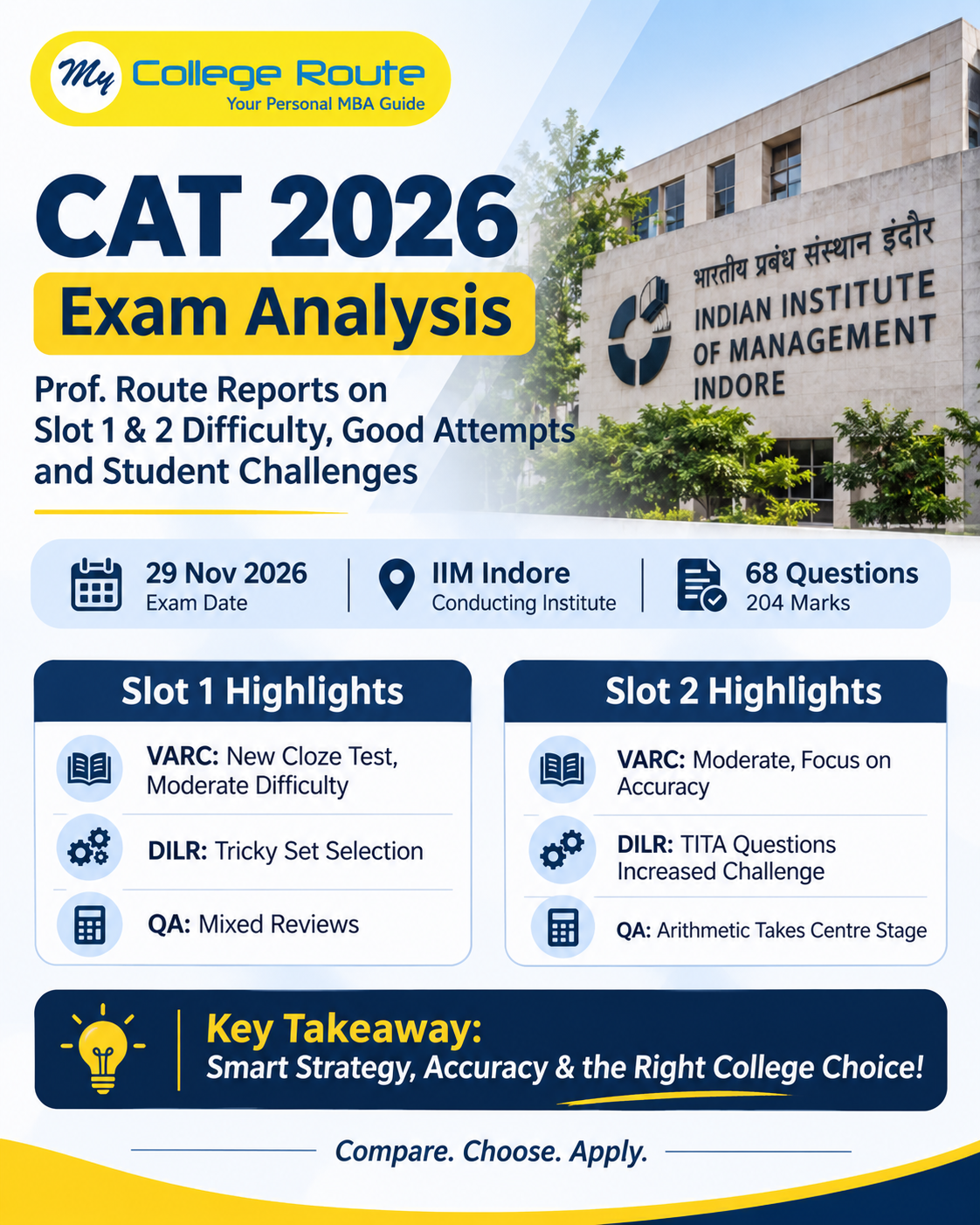
CAT 2026 Exam Analysis Live: The Common Admission Test (CAT) 2026, conducted by IIM Indore on 29 November 2026, has generated considerable discussion among MBA aspirants following the completion of its first two sessions. Initial assessments suggest that both Slot 1 and Slot 2 were moderately difficult, with unexpected changes in VARC, challenging DILR sets and varying experiences in Quantitative Aptitude.
In this special exam-day report, Prof. Route, the virtual education correspondent of My College Route, takes readers outside the CAT examination centres to explore how the examination unfolded, what made the paper challenging and why accuracy could become crucial in determining CAT 2026 percentiles.
CAT 2026 Exam Day: What's Happening Outside Examination Centres?
Imagine the atmosphere outside a CAT examination centre: students discussing difficult questions, comparing their attempts and wondering whether their performance will be sufficient for admission to their dream IIM.
Against this backdrop, Prof. Route brings a simple message:
"CAT is not about attempting every question. It's about selecting the right questions, maintaining accuracy and managing your time."
The first two examination sessions followed the familiar 120-minute pattern, with 40 minutes allocated to each section.
CAT 2026 Exam Highlights
-
Conducting Institute: IIM Indore
-
Exam Date: 29 November 2026
-
Total Questions: 68
-
Maximum Marks: 204
-
VARC: 24 questions
-
DILR: 22 questions
-
QA: 22 questions
-
Overall Difficulty: Moderate, based on preliminary assessments
CAT 2026 Slot 1 Analysis: What Surprised Aspirants?
The morning session, conducted from 8:30 AM to 10:30 AM, introduced some notable changes while maintaining the established examination structure.
VARC: How Did the New Cloze Test Change the Paper?
The VARC section included 24 questions, comprising 16 Reading Comprehension questions and eight Verbal Ability questions.
One of the biggest surprises was the introduction of Cloze Test questions, while the traditional Odd One Out format was absent.
Reading passages included abstract and analytical themes, requiring careful interpretation.
Initial student reactions varied, with some finding VARC manageable and others reporting challenging comprehension questions.
DILR: Why Was Set Selection Important?
DILR included 22 questions covering logical arrangements, data interpretation and multi-step reasoning.
The primary challenge involved identifying manageable sets without wasting valuable time.
Students who approached easier sets first were better positioned to maximize their attempts.
Quantitative Aptitude: Was QA the Toughest Section?
Quantitative Aptitude featured 22 questions, with Arithmetic, Algebra and Geometry among the important areas.
Some candidates reported lengthy calculations and time pressure, while others considered the section relatively manageable.
Therefore, Slot 1 QA difficulty remains subject to differing preliminary assessments.
CAT 2026 Slot 2 Analysis: Why Did DILR Challenge Candidates?
The afternoon session, held from 12:30 PM to 2:30 PM, was also considered moderately difficult.
However, DILR emerged as a particularly challenging section in the preliminary analysis.
VARC: Moderate With Emphasis on Accuracy
The 24-question VARC section tested Reading Comprehension, Para Summary, Para Jumbles and contextual language understanding.
Candidates needed strong fundamentals and careful interpretation rather than relying entirely on speed.
Indicative good attempts: 14–17 questions.
DILR: TITA Questions Increased the Challenge
The 22-question DILR section featured reasoning problems involving routes, arrangements, logical conditions and data interpretation.
A substantial share of TITA questions meant candidates could not rely on eliminating multiple-choice options.
Prof. Route's key takeaway is straightforward: smart set selection matters more than the number of sets attempted.
Indicative good attempts: 9–12 questions.
Quantitative Aptitude: Arithmetic Takes Centre Stage
Slot 2 QA focused heavily on fundamental Arithmetic topics, including:
-
Percentages
-
Mixtures and Alligations
-
Time, Speed and Distance
-
Time and Work
The section was assessed as moderate in the preliminary review.
Indicative good attempts: 11–14 questions.
These ranges are estimates, not official benchmarks or guaranteed percentile indicators.
CAT 2026 Slot 1 vs Slot 2: Which Was Tougher?
| Section | Slot 1 | Slot 2 |
|---|---|---|
| VARC | Moderate; new Cloze Test | Moderate |
| DILR | Tricky set selection | Difficult / Tricky |
| QA | Mixed difficulty reviews | Moderate |
| Overall | Moderate | Moderate |
Prof. Route explains that comparing slots only by perceived difficulty can be misleading.
CAT uses normalization to account for differences between examination sessions. Consequently, candidates should avoid drawing conclusions about their final percentile purely from post-exam discussions.
What Should CAT 2026 Aspirants Do Next?
With the examination complete for the first two sessions, students should focus on the next stages of their MBA admission journey.
Prof. Route recommends:
-
Check the official CAT 2026 answer key and response sheet when released.
-
Calculate your estimated raw score using the marking scheme.
-
Understand how CAT score normalization affects percentile estimates.
-
Compare MBA and PGDM colleges based on eligibility, fees, placements and ROI.
-
Track MBA Admission 2027 application deadlines.
-
Continue preparing for other management entrance examinations and interview rounds.
CAT 2026 Exam Analysis: Frequently Asked Questions
1. What was the difficulty level of CAT 2026 Slot 1?
CAT 2026 Slot 1 was broadly rated moderate, although students and experts reported different experiences across VARC, DILR and QA.
2. Why was CAT 2026 Slot 2 DILR considered difficult?
The section featured multi-step logical reasoning sets and numerous TITA questions, making time management and accuracy particularly important.
3. How many questions were asked in CAT 2026?
CAT 2026 contained 68 questions across VARC, DILR and Quantitative Aptitude, carrying a maximum of 204 marks.
4. How can students predict their CAT 2026 percentile?
Candidates can estimate their raw scores using the official response sheet and answer key. Percentile predictions should account for normalization and overall candidate performance.
Final Verdict: Prof. Route's Message to CAT 2026 Aspirants
CAT 2026 Slot 1 and Slot 2 demonstrated that management entrance examinations reward conceptual clarity, intelligent question selection and consistent accuracy.
While Slot 1 introduced unexpected Verbal Ability changes, Slot 2 tested candidates through demanding DILR sets and Arithmetic-focused Quantitative Aptitude.
For aspirants wondering "What happens after CAT 2026?", Prof. Route emphasizes that the journey is far from over.
"Your CAT performance is one part of your MBA journey. Choosing the right B-School is equally important."
For detailed CAT 2026 exam analysis, expected percentile updates, MBA admission news and college comparisons, visit My College Route — Compare. Choose. Apply.
Disclaimer: This report combines an illustrative Prof. Route correspondent narrative with preliminary CAT 2026 exam analysis. No direct on-site interviews are represented as having taken place. Difficulty assessments and good-attempt estimates may change as further verified information becomes available.
© 2026 mycollegeroute.com All Rights Reserved. Website designed by Orbit Inhouse