Bad CAT Mock Score? Don’t Panic — Analyze Concepts, Accuracy, Time Management and Question Selection
A bad CAT mock score can feel disappointing, especially when the exam is getting closer and every mock seems important. Many aspirants see one low mock score and immediately start thinking, “CAT is not for me,” “I will never improve,” or “My preparation is not enough.” But this is exactly where most students misunderstand the purpose of mock tests.
A CAT mock score is not a final verdict. It is a diagnosis.
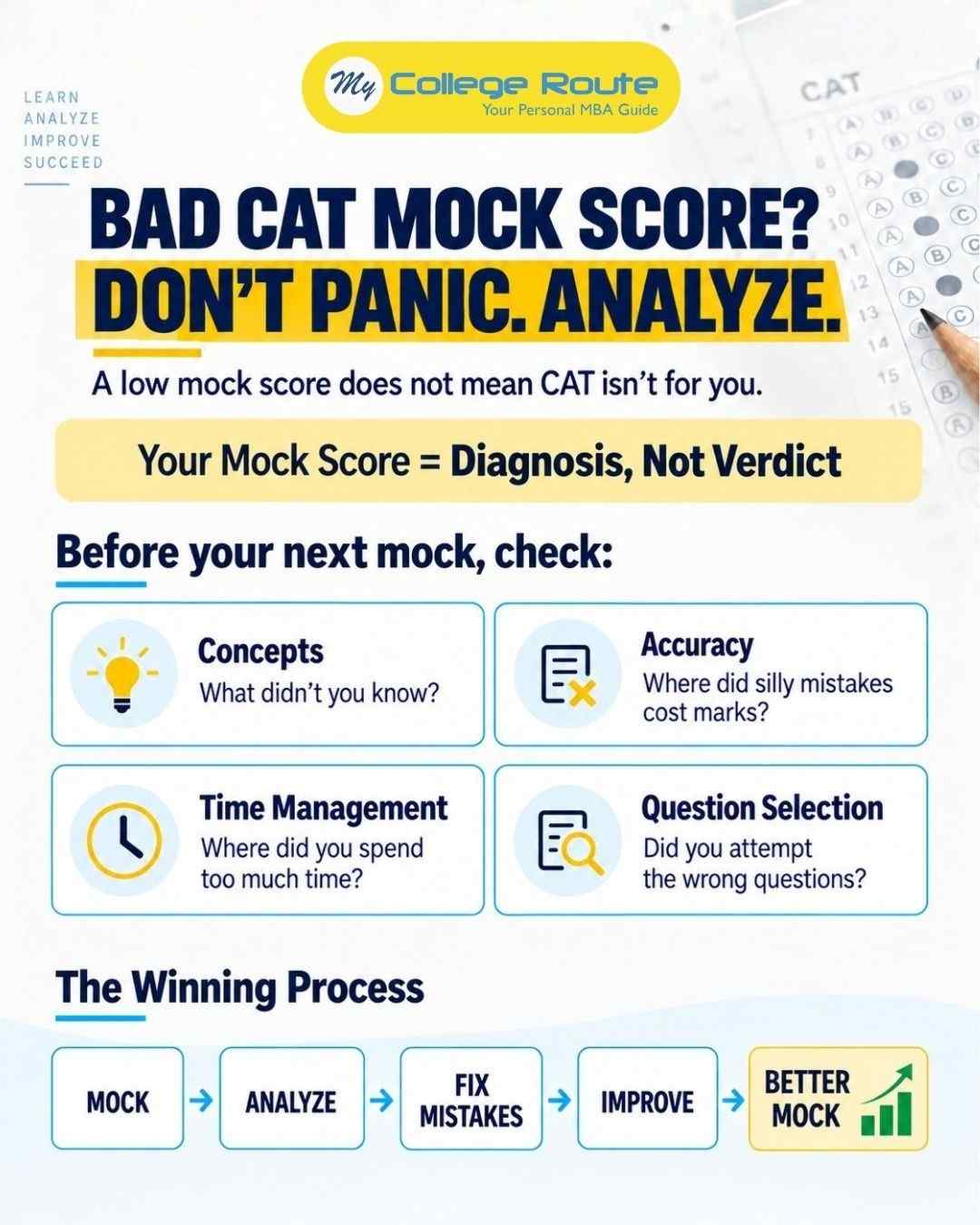
The image gives a very important message for every CAT 2026 aspirant: Bad CAT Mock Score? Don’t Panic. Analyze. A low mock score does not mean CAT is not for you. It simply means your preparation needs direction. Before your next mock, you must check four things:
- Concepts: What didn’t you know?
- Accuracy: Where did silly mistakes cost marks?
- Time Management: Where did you spend too much time?
- Question Selection: Did you attempt the wrong questions?
The winning process is also simple:
Mock → Analyze → Fix Mistakes → Improve → Better Mock
This article explains how CAT aspirants should analyze a bad mock score, what mistakes to identify, how to improve section-wise performance, why mock analysis is more important than mock count, and how to use every low score as a stepping stone toward a better CAT 2026 result.
Why a Bad CAT Mock Score Is Not the End
A bad mock score can hurt confidence, but it should not be treated as the end of your CAT journey. Mock tests are designed to show your current preparation level, not your final potential. If a mock exposes your weak areas, it has done its job.
Many students panic after a low mock because they compare their score with friends, toppers or online communities. But CAT preparation is personal. Every aspirant improves at a different pace. The real question is not, “Why did I score low?” The better question is, “What exactly caused the low score and how can I fix it?”
A low mock score can happen because of:
- Weak concepts
- Poor time management
- Low accuracy
- Wrong question selection
- Panic during the test
- Lack of revision
- Overattempting
- Underattempting
- Poor reading speed
- Calculation errors
- Lack of DILR set selection practice
- Not analyzing previous mocks
Once you know the reason, improvement becomes possible.
Your Mock Score is a Diagnosis, Not a Verdict
The most powerful line from the image is: Your Mock Score = Diagnosis, Not Verdict.
A diagnosis tells you what is wrong. It does not define your final result. Just like a medical test helps identify what needs treatment, a CAT mock test helps identify what needs correction in your preparation.
A mock score helps diagnose:
- Which topics are weak
- Which section needs more time
- Which questions you should skip
- Where silly mistakes happen
- Whether your attempt strategy is working
- Whether you panic under pressure
- Whether your preparation is balanced
If you treat a mock as a verdict, you will panic. If you treat it as diagnosis, you will improve.
Why Mock Analysis Matters More Than Mock Count
Many CAT aspirants proudly say, “I have taken 30 mocks” or “I have taken 50 mocks.” But the number of mocks does not matter if you are not analyzing them properly. Taking mocks without analysis is like writing tests repeatedly without learning from mistakes.
Mock count is useful only when:
- Every mock is reviewed properly
- Mistakes are recorded
- Weak areas are revised
- Attempt strategy is improved
- Time traps are identified
- Accuracy is tracked
- Recurring errors are fixed
One properly analyzed mock can teach more than five unreviewed mocks.
What to Check Before Your Next CAT Mock
Before taking the next mock, do not just move on from the previous one. Use the four-point checklist shown in the image:
- Concepts
- Accuracy
- Time Management
- Question Selection
These four areas explain most mock score fluctuations.
1. Concepts: What Didn’t You Know?
The first thing to check after a bad mock score is conceptual weakness. Ask yourself: did I lose marks because I did not know the topic?
Conceptual gaps are common in CAT preparation, especially in Quantitative Ability and Data Interpretation. Sometimes students attempt questions without fully understanding the concept, which leads to wrong answers and wasted time.
Concept-related mistakes include:
- Not knowing the formula
- Knowing the formula but not knowing where to apply it
- Confusing similar concepts
- Forgetting basic rules
- Misunderstanding question language
- Not recognizing question type
- Weak fundamentals in arithmetic, algebra or geometry
- Lack of exposure to DILR set types
- Poor understanding of RC question types
How to fix conceptual gaps
To improve concepts:
- Make a topic-wise error list.
- Identify repeated weak topics.
- Revise basics before solving advanced questions.
- Watch or read concept explanations again.
- Solve easy questions first.
- Move to moderate questions after clarity.
- Revise formulas daily.
- Attempt topic-wise sectional tests.
- Revisit previous wrong questions after 3–4 days.
Example
If you repeatedly make mistakes in time-speed-distance, do not simply solve more mocks. Go back to basics, revise relative speed, trains, boats, races and circular tracks. Then solve topic-wise questions before returning to mocks.
2. Accuracy: Where Did Silly Mistakes Cost Marks?
Accuracy is one of the biggest score deciders in CAT. Many students know the concept but still lose marks because of silly mistakes. These mistakes are frustrating because they were avoidable.
Common accuracy mistakes
- Calculation errors
- Reading the question incorrectly
- Marking the wrong option
- Missing words like “not,” “except,” “minimum” or “maximum”
- Wrong unit conversion
- Misinterpreting data
- Rushing through easy questions
- Guessing without logic
- Losing focus after a tough question
- Making assumptions not given in the question
How to improve accuracy
To improve accuracy:
- Slow down slightly in easy questions.
- Read the question twice before solving.
- Underline important conditions mentally.
- Avoid random guessing.
- Maintain clean rough work.
- Recheck calculations in Quant.
- Review options carefully.
- Track silly mistakes separately.
- Create an “accuracy error log.”
- Practise with a timer, but not at the cost of understanding.
Accuracy rule for CAT
It is better to attempt fewer questions with higher accuracy than attempt too many questions with poor accuracy. CAT rewards smart attempts, not reckless attempts.
3. Time Management: Where Did You Spend Too Much Time?
Time management is another major reason for low mock scores. Many students know the topic but spend too much time on one question or one DILR set. This reduces the time available for easier questions.
Time management mistakes include:
- Spending 5–7 minutes on one Quant question
- Getting stuck on a difficult DILR set
- Reading one RC passage repeatedly
- Trying to solve every question
- Not skipping early enough
- Attempting questions in the wrong order
- Starting with the toughest set
- Not tracking section-wise time
- Panicking after wasting time
How to fix time management
To improve time management:
- Set time limits for each question type.
- Skip questions that are not moving forward.
- Do not get emotionally attached to a problem.
- Practise timed sectionals.
- Create a section-wise attempt strategy.
- Learn to identify time traps.
- Review time spent after every mock.
- Practise easy-to-moderate questions for speed.
- Use mocks to test different attempt strategies.
Practical time rule
If you do not understand how to start a question within 60–90 seconds, mark it for review and move ahead. You can come back later if time allows.
4. Question Selection: Did You Attempt the Wrong Questions?
Question selection is one of the most underrated CAT skills. A low mock score often happens not because the student does not know enough, but because the student attempted the wrong questions.
CAT is not about solving every question. It is about selecting the right questions.
Poor question selection looks like:
- Starting with the hardest DILR set
- Ignoring easy questions
- Attempting unfamiliar topics first
- Spending time on lengthy calculations
- Guessing difficult questions
- Attempting low-confidence questions
- Leaving easy questions due to poor scanning
- Trying to prove yourself during the mock
How to improve question selection
To improve question selection:
- Scan the section quickly.
- Start with familiar topics.
- Attempt high-confidence questions first.
- Skip lengthy or confusing questions.
- In DILR, choose sets based on clarity and solvability.
- In VARC, start with passages you can understand better.
- In QA, attempt easy arithmetic and algebra questions first.
- Avoid ego-solving difficult questions.
- Review every skipped question after the mock.
Why question selection matters
A student who selects the right questions can score better with fewer attempts. A student who attempts the wrong questions may waste time and lose accuracy.
The Winning Process: Mock → Analyze → Fix Mistakes → Improve → Better Mock
The image shows the winning process clearly. This process should become the core of CAT 2026 preparation.
Step 1: Take the Mock Seriously
Every mock should be taken like the actual CAT exam. Do not pause the test, do not check answers midway and do not take calls or breaks during the test.
Before the mock:
- Sit in a quiet place.
- Keep rough sheets ready.
- Keep water nearby.
- Avoid distractions.
- Follow the timer strictly.
- Attempt with full focus.
Step 2: Analyze the Mock Deeply
After the mock, do not look only at the score. The score tells you what happened. Analysis tells you why it happened.
Analyze:
- Section-wise score
- Accuracy percentage
- Attempt count
- Time spent per question
- Easy questions missed
- Wrong questions attempted
- Silly mistakes
- Conceptual gaps
- DILR set selection
- RC passage selection
- Quant topic performance
Step 3: Fix Mistakes
Analysis is useless if you do not fix mistakes. After every mock, create an action plan.
Fixing mistakes means:
- Revising weak concepts
- Reattempting wrong questions
- Practising similar questions
- Improving calculation speed
- Revising formulas
- Changing attempt strategy
- Practising DILR set selection
- Improving RC reading method
Step 4: Improve Before the Next Mock
Do not take the next mock immediately without fixing the previous one. There should be improvement work between two mocks.
Between two mocks:
- Revise 2–3 weak topics.
- Solve similar questions.
- Practise one sectional test.
- Review your error notebook.
- Improve one specific strategy point.
- Avoid repeating the same mistake.
Step 5: Take a Better Mock
A better mock does not always mean a higher score immediately. It may mean:
- Better accuracy
- Better time management
- Fewer silly mistakes
- Better question selection
- Less panic
- Improved sectional balance
- More controlled attempts
Score improvement follows process improvement.
Section-Wise CAT Mock Analysis
CAT has three sections: VARC, DILR and QA. Each section requires a different analysis method.
VARC Mock Analysis
VARC is not just about English. It tests reading ability, comprehension, logic and option elimination.
Check these after VARC:
- Which RC passage was difficult?
- Did I choose the wrong passage first?
- Did I misread the author’s tone?
- Did I confuse inference with fact?
- Did I eliminate options properly?
- Did I spend too much time on one passage?
- Did I ignore VA questions?
- Did I get trapped by extreme options?
How to improve VARC after a bad mock
- Read daily for 30–45 minutes.
- Practise 2–3 RC passages daily.
- Analyze wrong options carefully.
- Learn passage selection.
- Summarize paragraphs mentally.
- Practise para summary and odd sentence questions.
- Avoid overthinking.
- Focus on evidence from the passage.
DILR Mock Analysis
DILR can create major score fluctuations. A student may perform well in one mock and poorly in another because set selection varies.
Check these after DILR:
- Did I choose the right sets?
- Did I spend too long on one set?
- Did I miss an easy set?
- Did I organize data properly?
- Did I panic after seeing unfamiliar sets?
- Did I solve questions partially?
- Was my rough work clear?
- Did I identify direct questions?
How to improve DILR after a bad mock
- Solve 2–3 sets daily.
- Practise mixed sets.
- Review unsolved sets.
- Learn to identify set difficulty.
- Build patience.
- Use tables and diagrams.
- Avoid starting every set blindly.
- Practise timed DILR sectionals.
QA Mock Analysis
QA performance depends on concept clarity, speed, accuracy and topic selection.
Check these after QA:
- Which topics gave wrong answers?
- Did I miss easy questions?
- Did I spend too long on difficult questions?
- Did I make calculation mistakes?
- Did I forget formulas?
- Did I attempt questions from weak topics first?
- Did I skip strong topics?
- Did I guess unnecessarily?
How to improve QA after a bad mock
- Revise arithmetic and algebra.
- Maintain a formula sheet.
- Solve 25–30 questions daily.
- Practise topic-wise tests.
- Review all wrong questions.
- Learn shortcuts only after understanding concepts.
- Focus on accuracy before speed.
- Build confidence in strong areas.
What to Do Immediately After a Bad Mock
A bad mock should be followed by a structured response.
Do this:
- Take a short break.
- Do not panic.
- Avoid comparing scores.
- Open the analysis section.
- Identify weak topics.
- Mark silly mistakes.
- Check time spent.
- Review skipped questions.
- Make an improvement plan.
- Fix mistakes before the next mock.
Do not do this:
- Do not quit preparation.
- Do not take another mock immediately.
- Do not blame the test.
- Do not change all resources suddenly.
- Do not copy someone else’s strategy blindly.
- Do not ignore the mock analysis.
How to Create a CAT Mock Error Log
An error log is one of the best tools for CAT improvement.
Your error log should include:
|
Error Type |
What to Record |
|
Concept Error |
Topic and concept missed |
|
Accuracy Error |
Silly mistake or calculation issue |
|
Time Error |
Question where too much time was spent |
|
Selection Error |
Wrong question or set attempted |
|
Strategy Error |
Poor attempt order or panic |
Review frequency
Students should review the error log:
- After every mock
- Twice a week
- Before every sectional test
- Before the final exam
An error log prevents repeated mistakes.
Why Mock Scores Fluctuate
Mock scores can fluctuate due to many reasons. A low score in one mock does not mean your preparation is failing.
Scores fluctuate because of:
- Different difficulty levels
- Different topic distribution
- Unfamiliar DILR sets
- Tough RC passages
- Poor sleep
- Low concentration
- Test anxiety
- Bad question selection
- Overattempting
- Underattempting
The key is to focus on trends, not one test.
How Many Mocks Should CAT 2026 Aspirants Take?
Mock count depends on preparation level. However, students should prioritize quality analysis.
Suggested mock plan:
- Early stage: 1 mock per week
- Middle stage: 1–2 mocks per week
- Final stage: 2–3 mocks per week
- Last week: selective mocks and revision
Taking too many mocks without improvement can reduce confidence. Every mock should teach something.
How to Turn a Bad Mock Into a Better Mock
A bad mock becomes useful when you extract lessons from it.
Improvement plan:
- Pick 3 major mistakes.
- Fix them before the next mock.
- Revise weak topics.
- Practise similar questions.
- Set a new attempt strategy.
- Track accuracy.
- Focus on process, not only score.
For example, if your DILR score dropped because you chose the wrong set, your next mock goal should be better set selection, not necessarily a huge score jump.
Quick Snapshot
What should I do after a bad CAT mock score?
Do not panic. Analyze concepts, accuracy, time management and question selection before taking the next mock.
Does a low mock score mean CAT is not for me?
No. A low mock score is a diagnosis, not a verdict. It shows what needs improvement.
How can I improve after a bad mock?
Create an error log, revise weak concepts, fix silly mistakes, improve time management and practise better question selection.
Why is mock analysis important for CAT?
Mock analysis helps identify the exact reasons behind low scores and guides your next preparation steps.
How do I avoid repeating mistakes in CAT mocks?
Maintain an error notebook and review it before every mock. Focus on fixing recurring mistakes.
How My College Route Helps CAT Aspirants
My College Route helps CAT aspirants move from confusion to clarity by providing:
- CAT preparation insights
- Mock test strategy
- Section-wise preparation guides
- College comparison
- Percentile-based college discovery
- Fees and placement comparison
- ROI analysis
- City-wise MBA college options
- Admission process guidance
- Application deadline tracking
Students can use My College Route to improve preparation and make informed MBA admission decisions.
Conclusion
A bad CAT mock score is not the end of your preparation. It is a signal. It tells you where your concepts are weak, where accuracy is dropping, where time is being wasted and where question selection needs improvement.
The right response to a bad mock is not panic. The right response is analysis.
Remember the winning process:
Mock → Analyze → Fix Mistakes → Improve → Better Mock
CAT 2026 aspirants should treat every mock as a learning opportunity. Scores may fluctuate, but consistent analysis and correction will build stronger performance over time.
Do not let one low mock score define your CAT journey. Learn from it, fix your mistakes and come back stronger in the next mock.
FAQs:
1. What should I do if I get a bad CAT mock score?
Stay calm and analyze the mock. Check concepts, accuracy, time management and question selection.
2. Does a low CAT mock score mean I cannot crack CAT?
No. A low mock score only shows your current preparation level, not your final potential.
3. Why is mock analysis important?
Mock analysis helps you understand why you lost marks and what you need to fix before the next mock.
4. How do I analyze CAT mocks?
Review each section, check wrong answers, identify time traps, mark weak concepts and track repeated mistakes.
5. What are the main reasons for a bad mock score?
Weak concepts, silly mistakes, poor time management, wrong question selection and lack of revision are common reasons.
6. How can I improve CAT accuracy?
Read questions carefully, avoid guessing, maintain clean rough work and track silly mistakes.
7. How can I improve CAT time management?
Use timed practice, skip difficult questions early and avoid spending too much time on one problem.
8. What is question selection in CAT?
Question selection means choosing the right questions to attempt based on difficulty, familiarity and time required.
9. Should I take another mock immediately after a bad score?
No. First analyze and fix mistakes, then take the next mock.
10. How many mocks should I take for CAT 2026?
Mock count depends on your preparation stage. Focus more on proper analysis than only increasing the number of mocks.
11. How do I create a mock error log?
Write down each mistake under concept error, accuracy error, time error, selection error or strategy error.
12. Why do CAT mock scores fluctuate?
Scores fluctuate because mocks vary in difficulty, topic mix, DILR sets, RC passages and your test-day focus.
13. Is mock score more important than mock analysis?
No. Mock analysis is more important because it helps improve future performance.
14. Can I improve CAT score in the final months?
Yes. With mock analysis, revision, better question selection and accuracy improvement, scores can improve.
15. How does My College Route help CAT aspirants?
My College Route helps students with CAT preparation guidance, mock strategy, college comparison, percentile-based shortlisting and MBA admission planning.
© 2026 mycollegeroute.com All Rights Reserved. Website designed by Orbit Inhouse