You DON’T Need 60 Attempts for 99%ile in CAT
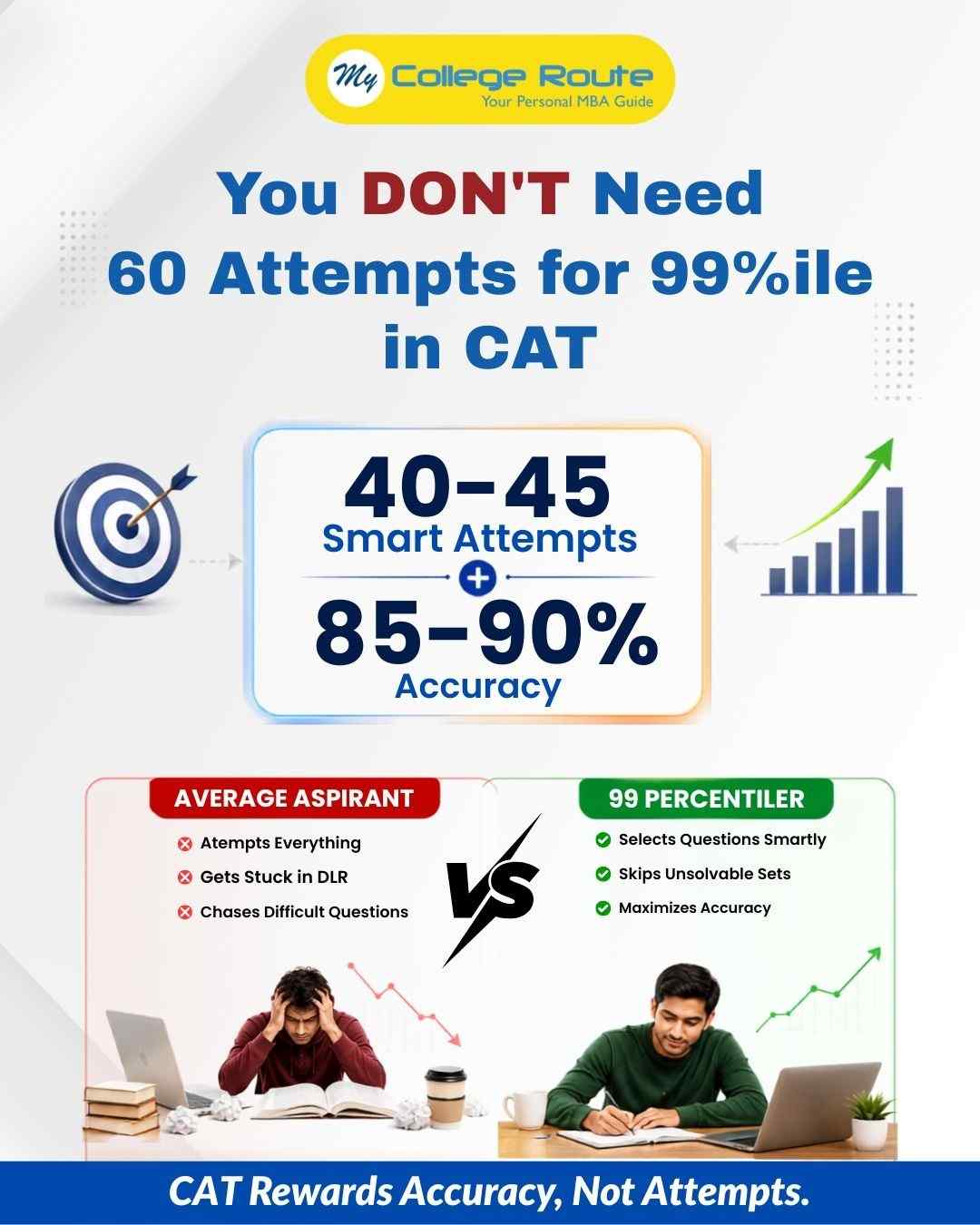
Many CAT aspirants believe that scoring 99%ile in CAT means attempting almost every question in the exam. The idea sounds simple: more attempts should mean more marks, and more marks should mean a higher percentile. But this is one of the biggest myths in CAT preparation. The truth is, you don’t need 60 attempts to score 99%ile in CAT. What you need is a smarter strategy, better question selection, strong accuracy, and calm decision-making under pressure.
CAT is not an exam where a maximum number of attempts guarantee success. It is an aptitude test where accuracy, time management, section-wise balance, and smart skipping matter more than blind speed. A student attempting 60 questions with poor accuracy can score much lower than a student attempting 40–45 questions with 85–90% accuracy. This is why CAT rewards accuracy, not attempts.
Every year, many serious MBA aspirants prepare for the CAT with the dream of getting into top B-Schools and MBA colleges such as IIM Ahmedabad, IIM Bangalore, IIM Calcutta, FMS Delhi, MDI Gurgaon, IIM Mumbai, SPJIMR, JBIMS, IITs, and other leading PGDM colleges in India. However, many students lose marks because they chase difficult questions, get stuck in DILR sets, attempt questions without confidence, and ignore mock analysis.
This article explains how many attempts are good in CAT, why accuracy matters more than attempts, what a smart attempt strategy means, how to improve CAT percentile with limited attempts, and why 40–45 smart attempts can be enough for a 99%ile if executed properly.
Why “More Attempts = Higher Percentile” Is a Dangerous Myth
The biggest mistake many CAT aspirants make is assuming that a high number of attempts automatically leads to a high percentile. CAT is different from school and college exams. You are not expected to solve everything. You are expected to choose wisely.
A high attempt count becomes risky when:
- You guess too many answers.
- You spend time on difficult questions.
- You lose accuracy under pressure.
- You panic in DILR.
- You attempt questions without complete understanding.
- You ignore easy questions because you are chasing tough ones.
- You do not manage time section-wise.
CAT has negative marking for wrong MCQ answers. This means a wrong answer not only wastes time but also reduces your score. Therefore, blind attempts can damage your percentile rather than improve it.
A smart CAT aspirant understands that the exam is not about showing how much you know. It is about scoring maximum marks from the questions you can solve accurately.
What Does 40–45 Smart Attempts Mean in CAT?
Smart attempts mean selecting questions that you can solve with confidence, within a reasonable time, and with high accuracy. It does not mean attempting only easy questions. It means avoiding unnecessary traps and maximizing the score from doable questions.
A 40–45 smart attempt strategy includes:
- Selecting easy and moderate questions first
- Skipping lengthy and confusing questions
- Avoiding ego-based solving
- Maintaining 85–90% accuracy
- Not getting stuck in one DILR set
- Solving RCs with proper comprehension
- Attempting Quant questions after checking the difficulty level
- Keeping enough time for review
If a student attempts 45 questions with around 85–90% accuracy, the score can be highly competitive, depending on the paper's difficulty level. CAT percentile depends on relative performance, paper difficulty, slot normalization, and section-wise score. Therefore, smart attempts with strong accuracy are far more valuable than random high attempts.
Why Accuracy Matters More Than Attempts in CAT
Accuracy is the real differentiator in CAT. Two students may attempt the same number of questions, but the one with better accuracy will score higher. Similarly, a student with fewer attempts but high accuracy can outperform a student with more attempts but poor accuracy.
Accuracy matters because:
- It protects your score from negative marking.
- It builds confidence during the exam.
- It improves section-wise percentile.
- It helps you avoid panic attempts.
- It supports better time management.
- It makes your mock analysis more meaningful.
- It increases your chances of getting calls from top B-Schools.
For example, attempting 55 questions with many errors may not be as effective as attempting 42 questions with very few mistakes. CAT does not reward effort; it rewards correct answers.
How 99%ilers Think Differently
A 99%ile does not enter the exam hall with the mindset of attempting everything. Instead, they focus on selecting the right questions. Their strategy is calm, practical, and score-oriented.
A 99%ile usually:
- Reads the paper strategically
- Identifies easy and moderate questions
- Skips unsolvable or time-consuming questions
- Maximizes accuracy
- Manages time section-wise
- Avoids emotional decision-making
- Does not panic after a tough section
- Analyses mock tests deeply before the final exam
An average aspirant often tries to prove their ability by solving difficult questions. A high scorer tries to maximize marks. This difference in mindset can change the final percentile.
Average Aspirant V/S 99%iler: What Is the Difference?
The difference between an average aspirant and a 99%iler is often not intelligence. It is a strategy.
Average Aspirant
- Attempts almost everything
- Gets stuck in DILR
- Chases difficult questions
- Takes wrong guesses
- Ignores easy questions
- Panics during low-scoring sections
- Does not analyze mocks properly
- Focuses only on syllabus completion
99%iler
- Selects questions smartly
- Skips unsolvable sets
- Maximizes accuracy
- Solves easy and moderate questions first
- Keeps calm under pressure
- Learns from mock mistakes
- Tracks accuracy and time
- Builds an exam-day strategy
This is why CAT is often called a selection game. You are not only selecting answers; you are selecting which questions deserve your time.
How Many Attempts Are Good in CAT?
There is no fixed number of attempts that guarantees the 99%ile, as CAT difficulty varies each year. However, a good attempt strategy depends on accuracy and paper difficulty.
In an easy paper, the number of good attempts may be higher. In a difficult paper, fewer accurate attempts may still lead to a strong percentile. Therefore, students should avoid rigid targets like “I must attempt 60 questions.”
Instead, focus on:
- Attempting questions you can solve correctly
- Maintaining section-wise balance
- Avoiding unnecessary risk
- Keeping accuracy above 85%
- Not wasting time on low-probability questions
For many aspirants, 40–45 smart attempts at 85–90% accuracy can build a strong foundation for scores. However, the final result depends on the exam pattern, difficulty level, normalization, and other candidates' performance.
What Is a Smart Attempt Strategy for CAT?
A smart attempt strategy means knowing how to handle each section differently. CAT has three sections: VARC, DILR, and QA. Each section needs a specific approach.
Smart Attempt Strategy for VARC
VARC includes Reading Comprehension and Verbal Ability questions. Many students think VARC is easy because it does not involve formulas, but it can be tricky. Options are often close, and overconfidence can reduce accuracy.
How to Attempt VARC Smartly
- Start with the RC passage that looks comfortable.
- Avoid passages that feel too abstract in the beginning.
- Read the question before or after the passage, depending on your comfort.
- Do not bring outside knowledge into RC answers.
- Eliminate extreme or unrelated options.
- Attempt para summary and odd sentence questions carefully.
- Avoid guessing in confusing VA questions.
- Track time for each passage.
Why Accuracy Drops in VARC
Accuracy drops on the VARC because students often choose answers based on feeling rather than evidence from the passage. CAT VARC requires logical reading, not emotional interpretation.
To improve VARC accuracy:
- Practice 2 RC passages daily.
- Read editorials and long-form articles.
- Analyze wrong options.
- Learn elimination techniques.
- Avoid over-attempting.
Smart Attempt Strategy for DILR
DILR is the section where many CAT aspirants lose confidence. It is unpredictable and can be time-consuming. A single wrong set selection can affect the entire section.
How to Attempt DILR Smartly
- Scan all sets in the first few minutes.
- Identify familiar and less lengthy sets.
- Avoid starting with the most confusing set.
- Do not force a set if no progress happens in 5–6 minutes.
- Solve one complete set accurately instead of three incomplete sets.
- Practice set selection during mocks.
- Keep calm even if the first set looks tough.
Why DILR Can Change Your CAT Percentile
DILR has fewer questions and high time pressure. If you select the right sets, you can score well. If you get stuck, your score can fall quickly. That is why DILR preparation is not only about solving puzzles. It is about learning which sets to attempt and which sets to skip.
Smart Attempt Strategy for QA
QA is a scoring section for students with strong conceptual understanding, but it can also be a trap if students chase difficult questions. CAT Quant often includes a mix of easy, moderate, and difficult questions. You do not need to solve every question.
How to Attempt QA Smartly
- First solve questions from your strong topics.
- Start with easy and moderate questions.
- Skip lengthy calculation-based questions in the first round.
- Avoid ego-solving difficult Algebra or Geometry questions.
- Use options smartly wherever possible.
- Mark questions for review only if they are genuinely doable.
- Revise formulas regularly.
- Maintain accuracy over speed.
Important QA Topics for CAT
- Arithmetic
- Algebra
- Geometry
- Number System
- Modern Math
- Mensuration
- Time, Speed and Distance
- Time and Work
- Percentages
- Ratio and Proportion
- Profit and Loss
- Simple and Compound Interest
Arithmetic is especially important for many aspirants because it is conceptually easier to grasp and often appears at various difficulty levels.
How to Improve Accuracy for CAT 2026
Improving accuracy is not a one-day task. It requires a disciplined practice routine and honest mock analysis.
Practical Ways to Improve CAT Accuracy
- Maintain an error log.
- Analyze every wrong answer.
- Identify whether the mistake was conceptual, silly or strategic.
- Avoid blind guessing.
- Practice timed questions.
- Review skipped questions after mocks.
- Revise formulas weekly.
- Track section-wise accuracy.
- Learn to leave questions without guilt.
- Build a calm exam temperament.
Accuracy improves when students stop treating every question as compulsory. A skipped question is not a failure. Sometimes, skipping is the smartest decision.
Why Mock Analysis Is the Key to 99%ile
Taking mocks is important, but analyzing mocks is more important. Many students take 30–40 mocks but repeat the same mistakes because they do not review them properly.
After every mock, ask:
- What went wrong?
- Which questions should I have skipped?
- Which easy questions did I miss?
- Where did I waste time?
- Why did my accuracy fall?
- Did I panic in any section?
- Which topic needs revision?
- Was my attempt strategy realistic?
Mock analysis helps you understand your behavior under pressure. It shows whether you are attempting to solve it smartly or randomly.
How to Analyze CAT Mocks Properly
Divide the mock analysis into four parts.
1. Accuracy Analysis
Check how many questions were correct out of the total attempts. If your attempts are serious but accuracy is low, reduce the number of risky attempts.
2. Time Analysis
Identify questions or sets where you spent too much time. This is especially important in DILR and QA.
3. Selection Analysis
Check whether you selected the right questions. Sometimes, students leave easy questions and spend time on difficult ones.
4. Concept Analysis
Review topics where you repeatedly make mistakes. Add them to your revision schedule.
What Should Be the Ideal CAT Mock Strategy?
A good mock strategy should be gradual. Do not start taking too many mocks without preparation.
Suggested Mock Plan
- Early preparation: 1 mock every 2–3 weeks
- Middle preparation: 1 mock every week
- Final 2 months: 2–3 mocks every week
- After every mock: minimum 3–4 hours of analysis
Taking mocks without analysis can create stress. Taking mocks with analysis creates improvement.
Why You Should Not Chase Difficult Questions
Many students feel that solving difficult questions will improve their percentile. This is only partly true. Difficult questions are useful during practice, but in the actual exam, the priority is scoring.
Chasing difficult questions can lead to:
- Time wastage
- Panic
- Missed easy questions
- Low accuracy
- Poor section-wise score
- Reduced confidence
Top scorers do not completely avoid difficult questions. They attempt them only when time and confidence support it.
How to Build a 99%ile Mindset
A 99%ile mindset is not about studying all day. It is about making every study session purposeful.
Build the Right Mindset By:
- Focusing on improvement, not perfection
- Analyzing mistakes without fear
- Practicing consistently
- Staying calm during bad mocks
- Avoiding comparison with others
- Trusting your strategy
- Building accuracy before speed
- Revising regularly
CAT preparation is a long journey. Motivation may fluctuate, but discipline must remain constant.
What Should Students Avoid During CAT Preparation?
Students often lower their own scores due to avoidable mistakes.
Avoid these mistakes:
- Attempting too many questions without accuracy
- Ignoring mock analysis
- Not revising formulas
- Solving random questions without a plan
- Comparing mock scores daily
- Taking too many resources
- Ignoring weak sections
- Over-attempting VARC
- Getting stuck in DILR
- Learning new topics in the final days
- Not sleeping properly before mocks or exams
How My College Route Helps CAT and MBA Aspirants
My College Route helps MBA aspirants make smarter preparation and admission decisions. From CAT preparation tips to MBA college comparison, B-School shortlisting, entrance exam updates, cut-offs, fees, placements, and admission guidance, the platform supports students at every stage of their MBA journey.
For students targeting top MBA colleges, top PGDM colleges, CAT-accepting colleges, CMAT colleges, XAT colleges, MAT colleges, and high-ROI B-Schools, My College Route provides structured information to reduce confusion and improve decision-making.
Conclusion
The headline is clear: You don’t need 60 attempts for the 99%ile in CAT. You need 40–45 smart attempts, strong accuracy, effective time management, and the ability to skip questions wisely. CAT is not about attempting everything. It is about selecting the right questions and maximizing the number of correct answers.
An average aspirant tries to solve everything. A smart aspirant solves what matters. That difference can decide the percentile.
To score high in CAT, focus on accuracy, mock analysis, question selection, revision, and calm execution. Do not chase attempts. Chase correct answers. CAT rewards accuracy, not attempts.
FAQs:
1. Do I need 60 attempts to score in the 99%ile in CAT?
No, you do not necessarily need 60 attempts to score in the 99th percentile in CAT. A lower number of smart attempts with high accuracy can also lead to a strong percentile rank, depending on the paper's difficulty and normalization.
2. What are smart attempts in CAT?
Smart attempts are questions carefully selected for difficulty, time requirement, and confidence level. They help students maximize accuracy and avoid unnecessary negative marking.
3. How many attempts are good in CAT?
There is no fixed number, but 40–45 smart attempts with 85–90% accuracy can be a strong strategy in many CAT scenarios. The ideal number depends on exam difficulty.
4. Why is accuracy important in CAT?
Accuracy is important because CAT has negative marking for wrong MCQ answers. High accuracy protects your score and improves your chances of getting a better percentile.
5. How can I improve my CAT accuracy?
You can improve CAT accuracy by analyzing mocks, maintaining an error log, revising concepts, avoiding blind guesses, and learning to select questions smartly.
6. What should I do if I get stuck in DILR?
If you get stuck in a DILR set and cannot make progress within a few minutes, move on. One fully solved set is better than multiple half-solved sets.
7. Is attempting more questions bad in CAT?
Attempting more questions is not bad if accuracy is high. The problem starts when students increase attempts through guesswork or poor question selection.
8. How many mocks should I take for CAT preparation?
Students should take mocks gradually. In the final two months, 2–3 mocks per week can be useful, provided each mock is analyzed properly.
9. What is better: high attempts or high accuracy?
High accuracy is more important than serious attempts. The best strategy is to balance attempts with accuracy, but blind attempts should be avoided.
10. How can My College Route help CAT aspirants?
My College Route helps CAT and MBA aspirants with preparation strategies, college comparison, entrance exam updates, cut-offs, fees, placements, ROI insights, and MBA admission guidance.
© 2026 mycollegeroute.com All Rights Reserved. Website designed by Orbit Inhouse